Environmental
E-waste

Contents
E-waste is the name given to electrical and electronic devices that have been thrown away because they have reached the end of their useful life or are simply no longer wanted. Any item that needs electricity, a battery or a circuit board to work can become e-waste once it is discarded.
It is not just computers
A common assumption is that e-waste means old computers, but the term covers every kind of electrical and electronic product. It is the type of item that makes it e-waste, not its size or its price.
- Kitchen and home items such as kettles, microwaves and smart speakers.
- Personal devices such as phones, tablets, earbuds and games consoles.
- Larger equipment such as televisions, printers and monitors.
- Small accessories such as chargers, cables, remote controls and battery packs.
Small items matter just as much as large ones: a single pair of wireless earbuds is e-waste in exactly the same way as a discarded desktop PC, because both contain circuitry and both have been thrown away.
Two reasons a device becomes e-waste
Devices reach the end of their life in different ways. Some are broken or worn out — a tablet whose battery no longer holds a charge has reached the end of its useful life. Others are no longer wanted while still working — a family buys a bigger television and takes the old one, still working, to the tip.
Worked example: a family clears out a spare room and puts out a cracked monitor, a games console nobody plays any more, a broken kettle and a bag of tangled chargers. Every one of these is e-waste, including the console that still switches on, because e-waste is defined by the item being discarded, not by whether it is faulty.
Either way, the device has been thrown away, so it is e-waste and has to be disposed of somehow.
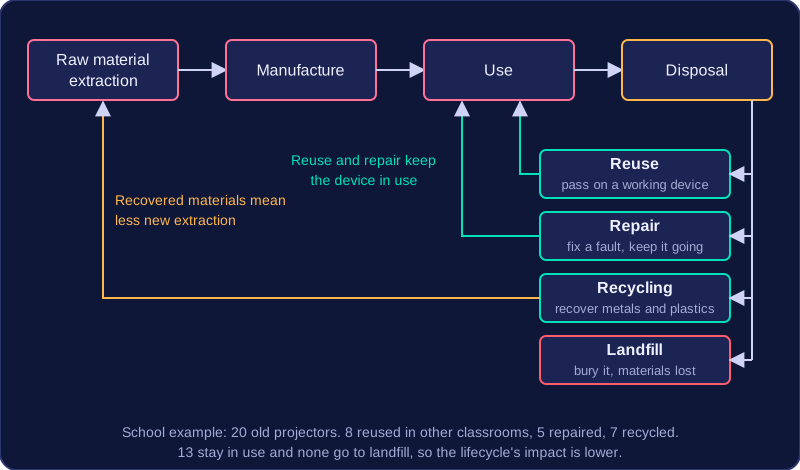
A digital device has a lifecycle: raw materials are extracted, parts are manufactured, the device is used, and finally it is disposed of. Disposal is what happens when a device is no longer wanted or working, and the devices thrown away then are e-waste. Disposal is not automatically the end of the device’s useful materials.
Lifecycle stages
| Stage | What happens |
|---|---|
| Raw material extraction | Metal ores are mined and oil is obtained to make the metals and plastics inside a device. |
| Manufacture | Materials are turned into components and assembled into a device, using energy. |
| Use | The device does the job it was bought for. |
| Disposal | The device is reused, repaired, recycled or sent to landfill. |
Raw material extraction and manufacture use resources and energy, so keeping a device in use for longer means these stages are not repeated as soon, lowering the overall environmental impact.
Disposal choices
- Reuse — pass on a working device to someone else. The materials and energy already used go to further use, so no new device is manufactured for that person.
- Repair — fix a fault so the device keeps working. This delays disposal, and with it the need for a replacement, so the impact of manufacture is spread over more years of use.
- Recycling — separate and recover materials such as metals and plastics. Recovering them reduces the need to extract new raw materials and keeps the device out of landfill.
- Landfill — bury the device. Its materials are not recovered, so more raw materials must be extracted for new products, and the device takes up space in the ground.
The environmental impact of disposal therefore depends on the method chosen and on whether materials are recovered. As an example, a school clears out 20 old digital projectors. Sending all of them to landfill loses their metal and plastic. Instead, 8 that still work go to other classrooms, 5 are repaired, and the other 7 are recycled: 13 projectors stay in use instead of being replaced, and the materials in the rest are recovered. The impact is lower across the whole lifecycle, because disposal decisions are part of the lifecycle, not a separate issue.
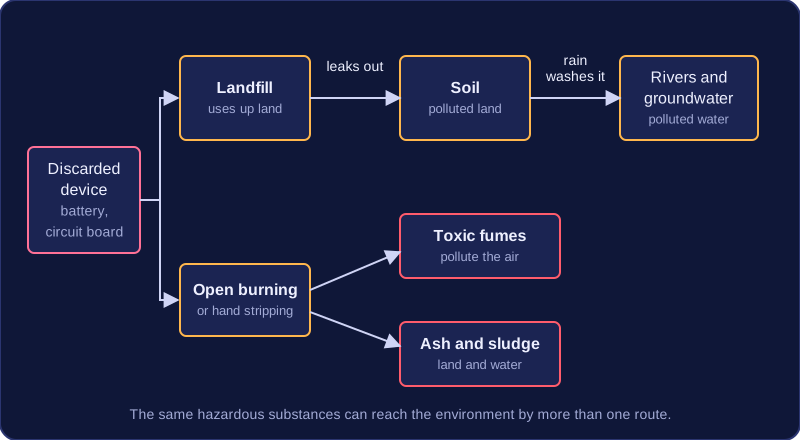
Digital devices can contain hazardous substances — materials that are dangerous to living things and to the environment around them. While a device is being used, those materials stay sealed inside it. Once the device is thrown away, careless disposal can let them escape and cause pollution, which means damage to air, land or water.
Landfill
Burying e-waste in landfill causes problems in two ways. The waste takes up land, so that space can no longer be used for homes, farming or wildlife. Over time the outer casing of a device can crack or corrode, and substances from batteries and circuit boards leak into the surrounding soil. Rainwater then washes those substances into streams, rivers and underground water, so the pollution spreads far beyond the tip.
For example, a cracked tablet dropped into a household bin is buried with general rubbish. Its battery slowly corrodes, and the chemicals inside seep into the soil beneath it and then into a nearby ditch after heavy rain.
Burning and unsafe processing
Some e-waste is set alight or pulled apart by hand to reach the metals inside. Burning plastic casings, cables and circuit boards releases toxic fumes into the air: gases and fine particles that are poisonous to breathe and that later settle on land and water nearby. The ash and sludge left behind are contaminated too, so the harm carries on after the fire has gone out.
Three kinds of pollution
| Where | How e-waste causes it |
|---|---|
| Air | Open burning of plastics and cables releases toxic fumes and particles |
| Land | Landfill uses up land, and leaking chemicals contaminate the soil |
| Water | Rain washes leaked chemicals and ash into rivers and underground water |
The same hazardous substances can reach the environment by more than one route, which is why disposing of devices properly matters so much.
E-waste processed in unsafe ways can harm people, wildlife and natural surroundings. Unsafe processing includes burning plastic-covered cables in the open to expose the copper inside, smashing devices apart by hand, and using strong acids to strip metals from circuit boards.
Harms to workers and communities
Workers at unsafe processing sites can breathe in toxic fumes given off by burning plastics and by metals such as lead, which can damage the lungs and nervous system. Acid used to recover metals can burn skin and eyes, especially when there is no protective clothing. Whole communities can be affected too: harmful substances may seep into soil and drinking water or contaminate food grown nearby, and children playing on or near a dump are exposed to the same hazards.
Harms to ecosystems and wildlife
When residues are left on the ground or washed into streams, ecosystems can be damaged. Toxins can kill plants, insects and fish, and can build up in the bodies of animals that eat contaminated food. Wildlife may also mistake small plastic and metal pieces for food, or become tangled in cables and broken casings.
Why exporting e-waste increases the risk
E-waste is often transported to other countries for processing, where safety and environmental standards may be lower. Sending waste to a site with weaker regulation can be cheaper, but workers may have little protective equipment and waste may be dumped or burned instead of being contained safely. For instance, a school might pay a waste contractor to take away its old monitors, only for them to be sold on to a yard where workers smash them open with hammers and rinse the shredded parts in a nearby stream.
Recycling e-waste means sending discarded digital devices to a recycling centre or reprocessing plant so that their materials and components can be separated and recovered. Instead of being thrown away, the device is treated as a source of useful parts and materials.
What happens at a recycling centre
When collected e-waste arrives at a recycling centre, workers and machines handle it in stages:
- Devices are sorted by type and condition.
- They are dismantled so that parts such as circuit boards, drives and cables can be removed.
- The remaining materials are separated into groups, such as metals, plastics and glass.
- Recovered materials are sent on for reprocessing, where they can be used to make new products.
Separation is important because a device is a mixture of materials. Once they are separated, each material can be recovered and used again rather than being lost.
Recovering valuable materials
Digital devices contain materials — some of them valuable — that can be recovered through recycling. For example, an old games console may contain metal in its circuit board and cables, plastic in its casing, and small amounts of precious metal in its connectors. If the console is simply thrown away, those materials are not recovered and their value is lost. If it is recycled, the centre can separate the parts and recover the materials so they can be used again.
Recycling e-waste means sending discarded digital devices to a recycling plant where their materials and components are separated so the useful ones can be recovered. It is usually better than sending devices to landfill, but it still has an impact of its own.
Benefits
Every device contains materials that took mining, fuel and energy to produce. Copper in cables, aluminium in cases and small traces of gold on circuit boards are all worth recovering. Many of these materials are non-renewable, meaning the supply in the ground is limited and will not be replaced. Recovering them conserves resources and reduces the need to extract new raw materials, so there is less mining damage and less energy spent refining ore. Recycling also reduces the volume of e-waste sent to landfill, which saves land and lowers the chance of harmful substances escaping into soil and water. Making a new product from recycled metal usually takes less energy and causes less pollution than starting from fresh raw materials.
Limits
Recycling is not impact-free. Collecting devices from homes and schools, driving them to a recycling plant and running the shredding and separation machinery all use energy, often from burning fossil fuels. Processing can also create hazardous waste, because parts such as the backlights in older screens and the solder on circuit boards contain substances that must be removed and handled carefully, or they can harm people and the environment.
For example, a college replaces 120 old desktop computers. The metal recovered from their cases and cables saves ore from being mined, but the fuel for two van trips and the plant's electricity are part of the cost. Recycling is still worth doing because the savings are usually much larger than these costs, but it reduces the damage rather than removing it completely.
Recycling e-waste is harder than recycling a single material such as paper. A digital device is a tightly packed mixture of materials, and some parts are hazardous, so they must be separated and handled safely before anything can be recovered.
Difficulties
Devices contain mixed materials. A discarded office printer is a good example: its plastic casing clips onto a steel frame, the glass scanner bed is fixed in place, and copper cabling and circuit boards carrying small amounts of valuable metals run through the middle. These parts are joined together, so a recycling plant must take the device apart or shred and sort it before each material can be recovered.
Batteries are a serious difficulty. If a lithium battery is crushed, punctured or overheated during sorting, it can catch fire or explode. This can damage equipment and injure workers. Batteries sealed inside devices are especially hard to remove: for example, the small cell in a musical birthday card is glued into a sealed plastic shell, so freeing it without damage needs special tools and care.
Improvements
Recycling can be improved by safer removal of hazardous parts: workers can take out batteries first and store them separately, away from flammable materials. Better sorting and processing, such as machines that separate metals from plastics and safe shredding after batteries have been removed, recover more material and lower fire risk. Stronger regulation can require manufacturers to make batteries easier to remove, set safety rules for recycling plants, and ensure e-waste is not sent to unsafe sites.
| Difficulty | Why it makes recycling hard | Improvement |
|---|---|---|
| Mixed materials | Parts are joined together, so they must be separated before recovery. | Better sorting and processing |
| Battery fire risk | Damaged batteries can catch fire or explode. | Safer removal of hazardous parts |
| Sealed batteries | Glue and tiny cases make batteries difficult to take out. | Stronger regulation to make batteries easier to remove |
E-waste is reduced most simply by keeping each device in use for longer, so fewer devices are thrown away. Every extra year you get from a device is a year in which no new one has to be manufactured from raw materials.
Reuse and repair first
Reuse means passing a working device on to someone who still needs it, and repair means fixing a fault so that the same device carries on working. Both extend its useful life, so the device stays in use for longer before it becomes e-waste. If a tablet no longer holds its charge, fitting a new battery can give it several more useful years. Disposing of a device that still works, or that a technician could fix, wastes the materials and the energy already spent on making it — the value built into it is thrown away.
Replacement cycles
A replacement cycle is how long you keep a device before swapping it for a new one. A short cycle means devices are bought and disposed of more often, so more e-waste builds up; a longer cycle means fewer devices are bought and thrown away over the same period. For example, a school that replaces 40 classroom tablets every 3 years gets rid of four sets in 12 years (160 tablets). Stretching the cycle to 6 years means only two sets (80 tablets) are discarded in the same time, halving the e-waste. A longer cycle reduces the disposal problem, but it does not remove the impact of manufacturing and using the devices.
Actions that reduce e-waste
| Who | What they can do |
|---|---|
| Consumers | Repair and reuse devices, use proper recycling schemes, and choose products designed to last |
| Manufacturers | Design products that last longer, can be repaired, and are easy to dismantle and recycle |
| Governments and organisations | Provide recycling facilities and take-back schemes, educate people, and pass laws |
These actions work together: a repairable design only cuts e-waste if people choose to repair rather than replace, and convenient recycling or take-back schemes make that choice realistic.