Compression
Lossy Compression
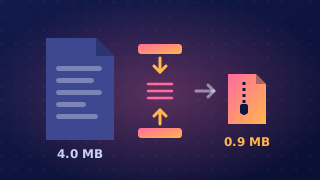
Lossy compression reduces a file's size by permanently removing some of its data. The removed data is thrown away, so decompressing the file gives you an approximation of the original, not an exact copy.
It works because not every piece of data in a photo, sound recording or video matters equally to your eyes and ears. A lossy compressor targets data that is least noticeable or least important to human perception. For example, in a recording of a school choir, very quiet sounds masked by the singing might be discarded. The singing still sounds normal, but those quiet sounds can never be recovered.
Because it removes data rather than only storing it more cleverly, lossy compression can reach a high compression ratio. A file can become a small fraction of its original size, which saves storage space and makes downloading or streaming quicker.
The trade-off is that heavy lossy compression can introduce artefacts — visible blocks or patches in an image, or a watery, buzzing sound in audio. These appear because detail has been removed for good. The file is now an approximation, not the original.
Lossy compression suits images, audio and video, where small losses often go unnoticed. It is not suitable for text or program code: a missing letter can change a word, and a missing instruction can stop a program working correctly.
Practise this
Edexcel GCSE Computer Science · Compression