Sound
Limitations of Digital Sound
A digital recording is only an approximation of the original analogue sound wave. The computer does not store the smooth curve itself; it stores measurements taken at particular moments and saves each measurement using a limited number of bits.
Rounding each sample
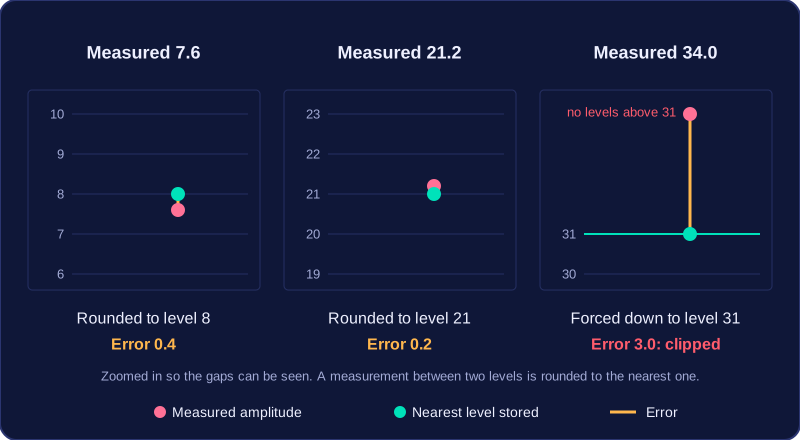
With a fixed bit depth, there are only a set number of amplitude values available. If a sample's measured amplitude falls between two of those values, it is rounded to the nearest one. That small difference is the rounding error. For example, a 5-bit system has 32 levels, numbered 0 to 31:
| Measured amplitude | Nearest available level | Error |
|---|---|---|
| 7.6 | 8 | 0.4 |
| 21.2 | 21 | 0.2 |
| 34.0 | 31 (maximum) | 3.0, clipped |
The first two samples are close to a stored level, so the error is small. The third is louder than the highest level the system can store, so it cannot be recorded properly; it is forced down to 31 and the loud peak is clipped.
More bits still isn't exact
Increasing the bit depth gives more possible levels and a wider range of amplitudes. The gaps between neighbouring levels get smaller, so rounding errors shrink and fewer peaks are clipped. But the original wave is continuous: between any two stored levels there are infinitely many possible amplitudes. No matter how many bits you use, a measured value can still land between two levels and need rounding. Also, only the values at the sample moments are stored, so anything happening between samples is missed. A higher bit depth improves the approximation but can never make the digital copy exact.
Practise this
Edexcel GCSE Computer Science · Sound