Sound
Bit Depth
Bit depth, also called sample resolution, is the number of bits used to store each sample. A sample is one measurement of the height of a sound wave, so the bit depth sets how precisely that height can be written down in binary.
With a bit depth of n bits, there are 2^n possible amplitude values. For example, 3 bits give 2^3 = 8 values, while 6 bits give 2^6 = 64 values. Each extra bit doubles the number of levels available.
| Bit depth | Calculation | Possible amplitude values |
|---|---|---|
| 2 bits | 2 ** 2 | 4 |
| 4 bits | 2 ** 4 | 16 |
| 8 bits | 2 ** 8 | 256 |
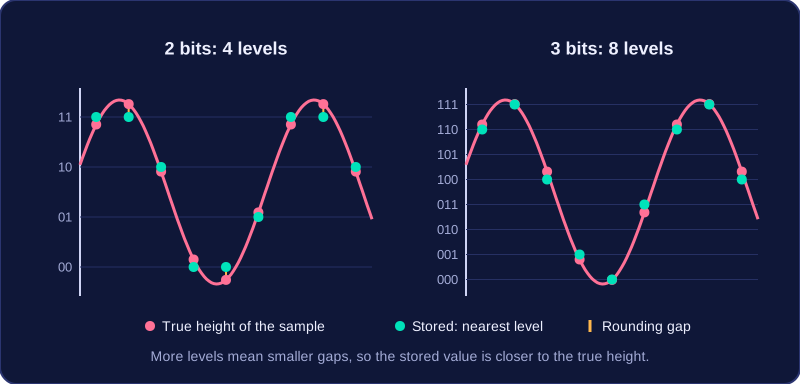
A higher bit depth records the height of each sample more accurately. The real height usually falls between two available values, so the recorder stores the nearest one. More levels mean smaller gaps between them, so the rounding error is smaller and the stored amplitude is closer to the true amplitude.
Bit depth changes precision, not timing: it does not decide how often samples are taken. It is also not the same as colour depth, which is used for images.
Practise this
Edexcel GCSE Computer Science · Sound