Unsigned Binary to Negative Binary Conversion
Two's Complement to Denary
An 8-bit two's complement pattern that begins with a 1 in the most significant bit (the sign bit) stands for a negative number. To turn it into denary, use flip the bits and add one: change every 0 to a 1 and every 1 to a 0, add 1 to what you get, read that as the positive size, then put a minus sign in front.
The steps in order
- Check the leftmost bit is 1, so the value is negative.
- Flip all eight bits, not just some of them.
- Add 1 to the flipped pattern, working from the right-hand end.
- Read the result as an ordinary unsigned value.
- Write that value with a minus sign.
A worked example
Take 11011001.
- Flip it:
00100110 - Add 1:
00100111 - Read it: 32 + 4 + 2 + 1 = 39
- So
11011001represents -39.
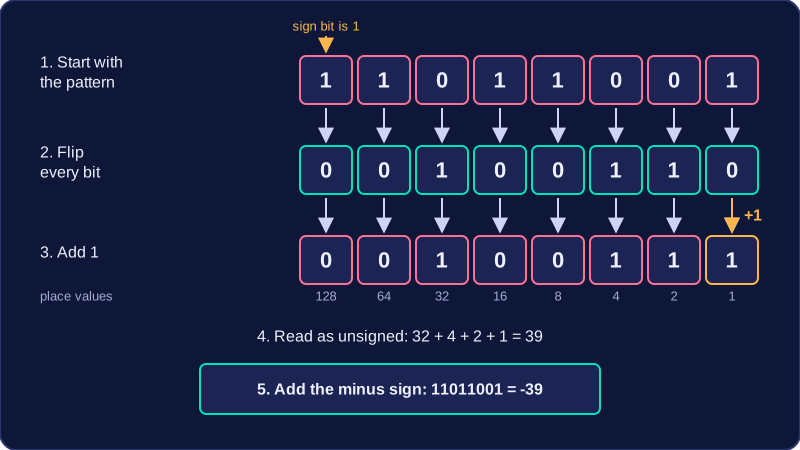
Stopping at 39 gives a positive answer, which is wrong: the pattern stores a negative value, so the minus sign is part of the answer, not an optional extra. Nor is the sign bit a marker sitting outside the number. It is a real bit with a place value of -128, which is why any pattern starting with 1 is worth less than zero.
The same two steps work the other way round: to find the pattern for a negative denary value, write its positive size in binary, flip every bit and add 1. Converting each way is a mirror image of the other, so the method never changes.
Practise this
Edexcel GCSE Computer Science · Unsigned Binary to Negative Binary Conversion