Unsigned Binary to Negative Binary Conversion
Converting Negative Denary to Two's Complement
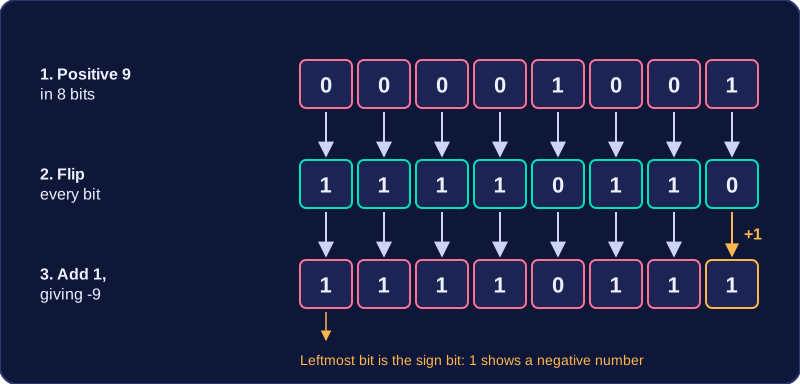
Two's complement is the method computers use to store negative whole numbers in binary. To turn a negative denary number into its 8-bit two's complement pattern, start from the positive version of the number and follow three steps: write the positive value in 8 bits, flip every bit, then add 1.
Carrying out the three steps
- Write the positive value as 8 bits. Pad with leading zeros so the pattern is exactly 8 bits long.
- Flip every bit. Every 0 becomes a 1 and every 1 becomes a 0. Missing even one bit spoils the answer.
- Add 1 to the flipped pattern. Do the addition in binary, carrying where two 1s meet, and keep the answer to 8 bits.
The flip on its own gives a pattern that is one less than the value you need: the flipped 9 is 11110110, which is -10, not -9, so the add-one step must come after the flip, never before. A quick check on your answer: a negative number always starts with a 1 in the leftmost bit, while a positive number starts with 0. You only use these steps for negative values, because a positive number's pattern is already correct as it stands.
Worked example for -9
| Step | 8-bit pattern |
|---|---|
| Positive 9 in binary | 00001001 |
| Flip every bit | 11110110 |
| Add 1 | 11110111 |
So -9 is stored as 11110111. A second run-through: positive 20 is 00010100, which flips to 11101011, and adding 1 gives 11101100 for -20.
Practise this
Edexcel GCSE Computer Science · Unsigned Binary to Negative Binary Conversion