Business Operations
Stock control

Stock control is managing the amount of stock a business holds so that it has enough at the right time, without holding too much. Enough stock keeps production and sales moving; excess stock uses space and cash that could be used elsewhere.
Good stock control improves productivity because employees are less likely to wait for materials, and efficiency because less time and space are wasted storing and checking stock. It improves profitability by reducing wasted stock and lost sales. For example, a bike shop that runs out of helmets during a busy weekend loses sales, while one holding hundreds of spare helmets ties up cash and may have to discount old colours.
Computerised stock control
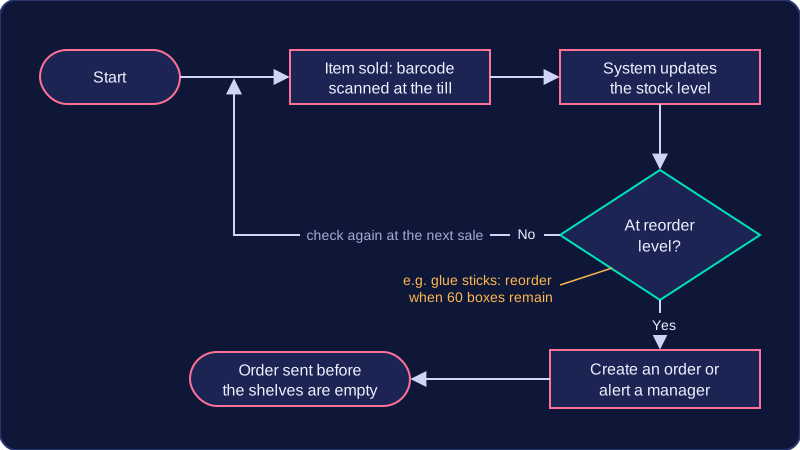
A computerised stock control system records stock levels each time an item is sold or used, such as when a barcode is scanned at a till. It applies the same principles as a bar gate stock graph: the business sets the levels and triggers that show when stock needs attention, and the system checks the stock level continuously.
When stock falls to the reorder level, the system can create an order automatically, or alert a manager to approve one. This reduces the chance of running out, cuts the time spent counting stock and gives managers up-to-date information for decisions. For example, a stationery supplier could set its system to reorder glue sticks when 60 boxes remain, so the order is sent before the shelves are empty.
Practise this
Edexcel GCSE Business · 2.3.2 Working with suppliers