Revision notes
Business Operations

Contents
- Quality and customer expectations
- Consistent quality
- Quality and competitive advantage
- Quality control
- Quality assurance
- Monitoring quality
- Costs and benefits of quality management
- Stock
- Stock control
- Bar gate stock graphs
- Responding to stock problems
- Just in time (JIT)
- Procurement
- Supplier choice
- Logistics
- Business operations
- Job production
- Batch production
- Flow production
- Productivity
- Automation in production
- Production trade-offs
Quality means a good or service is fit for purpose: it does the job the customer bought it for and meets their needs. Quality is not the same as luxury or a high specification. A cheap product can be good quality, and an expensive one can be poor quality if it fails at what it promises.
Fit for purpose, not fancy
A £10 school bag that keeps books dry and survives a year of being thrown about is good quality. A designer bag whose zip breaks in a week is not, however much it costs. The same idea applies to services. A barber who gives you a neat cut at the time you booked has delivered quality, even without free drinks or a fancy salon.
Expectations vary
Different customers need different things, so they judge quality differently.
| Customer | What they need | What quality means to them |
|---|---|---|
| A student cycling two miles to school | A safe, cheap bike | Working brakes and a sturdy frame; £140 is enough |
| A courier making 40 deliveries a day | A bike that rarely breaks down | Strong components and low repair bills; £900 is worth it |
Both customers are right. A bike that suits one may not suit the other, so a business needs to know who its target customers are before it decides what quality means for them.
Value for money affects the price customers will pay
The price a customer is willing to pay depends on the value for money they expect: what they get compared with what they pay. Value for money does not mean the lowest price. Headphones costing £60 with a two-year guarantee may feel like better value than £25 ones that break in three months. If a product looks poor value at its price, customers go elsewhere; if it beats their expectations, they may happily pay more next time.
Consistent quality means that every item a business produces, or every service it provides, reaches the same standard each time a customer buys. The second visit should feel as good as the first, and the tenth product should be as reliable as the first.
Customers rely on this. When someone buys again, they are judging the business on what happened last time, and they expect the same experience. A service is really a promise about how it will be delivered, so a business that keeps that promise builds a reputation customers trust.
Why inconsistent quality causes problems
- Disappointment: a customer whose first visit was excellent and whose second was poor feels let down, because the business itself set the expectation.
- Complaints: faulty or rushed work leads to refunds, replacements and staff time spent putting things right, all of which cost money.
- Reduced trust: a customer who cannot predict what they will get may stop buying altogether, and unhappy customers often tell friends and family.
These effects damage customer satisfaction, reputation and sales. Bad experiences spread quickly by word of mouth and can cancel out the good reviews a business has earned.
For example, a car wash charges £9 for a full clean. One Saturday the staff take their time and the car leaves spotless; the next Saturday they rush and miss the wing mirrors and the wheels. The customer cannot rely on the service, switches to a rival down the road and warns two friends. Nothing about the price changed, but the standard did.
Standardising to keep quality steady
Businesses aim to standardise their processes so that quality does not depend on who is working or when. Written procedures, set recipes, set scripts and regular training mean a busy Saturday shift performs like a quiet Tuesday one. This matters just as much for services, because the customer judges the whole experience, including waiting time, how staff behave and the final result, not just a finished product.
A competitive advantage is something that makes customers choose one business instead of its rivals. Good quality can be a competitive advantage because it makes a product or service different from what competitors offer. If customers believe your goods or services meet their needs better, they have a reason to choose you.
Good quality also encourages customer loyalty. Customers who trust the standard are more likely to buy again and recommend the business to others. Loyalty gives a business steadier revenue and makes customers less likely to switch to a rival over a small price difference. Some customers will pay a higher price for quality they trust. A higher price increases revenue per sale; if the extra income is greater than any extra cost of providing the quality, profit can rise.
For example, a mobile bike repair service that arrives on time, explains the work clearly and uses reliable parts might charge £10 more per repair than a rival. Riders trust it, rebook and recommend it, so sales and profit can grow.
Poor quality compared with competitors works against a business. Faulty goods or a poor service experience damage reputation, especially when customers post reviews or tell friends. Sales can fall as customers switch to rivals, and the business may have to spend money fixing mistakes or winning customers back. Quality therefore affects competitiveness, not just customer satisfaction. It can support a brand image in the marketing mix, but the business must actually deliver the standard it promises.
| Good quality | Poor quality |
|---|---|
| Customers trust the product or service to meet their needs | Customers lose trust after faults or poor service |
| Repeat purchases and recommendations are more likely | Customers may switch to a rival |
| Some customers will accept a higher price | Discounts may be needed to keep sales |
| Revenue and profit can rise | Reputation and sales can fall |
Quality control is the process of checking that goods or services meet a required standard. It detects faults by comparing output with the standards the business has set.
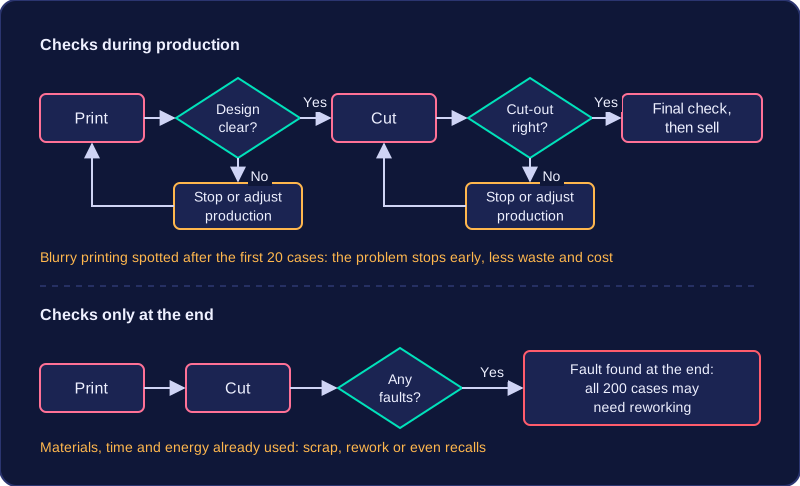
Quality control usually involves inspecting output. Many businesses check finished goods before they are sold, but checks can also take place at stages during production. Imagine a firm making phone cases. It might check the printed design after printing and the camera cut-out after cutting. If the printing is blurry, staff can stop or adjust production before more cases are printed badly. If 200 cases are printed before the fault is spotted at the end, all 200 may need reworking; a check after the first 20 could stop the problem much sooner.
Why the timing of checks matters
Checking during production can identify problems early and reduce waste and cost. Relying only on checks at the end means faults may be found after materials, time and energy have already been used, so the business may have to scrap or rework items, or recall products from customers. Quality control still detects faults after they have happened, so it cannot prevent every fault. It is not the same as quality assurance, which manages quality throughout production rather than checking output at the end.
| When the check happens | What it can do | Possible result |
|---|---|---|
| During production | Spots a fault early so production can be stopped or adjusted | Less waste and lower cost |
| Only at the end | Finds the fault after resources have been used | More waste, rework or recalls |
Quality control in services
Services need quality control too. A service is often delivered and used at the same time, so checks happen as it is delivered rather than only once it is finished. A mobile bike repair service, for example, might test the gears straight after adjusting them, then test the brakes before handing the bike back. If something is wrong, it can be put right before the customer rides away, instead of becoming a complaint later.
Quality assurance is the system a business uses to make sure that the quality of production meets customer needs throughout the whole production process. Rather than leaving quality to be checked once the item is finished, it builds quality into every stage, from choosing materials to packing the finished item.
This makes quality assurance broader than quality control. Quality control checks output against a standard and aims to detect faults. Quality assurance looks at the whole process and aims to prevent faults from happening in the first place. In a business using quality assurance, every employee is often responsible for quality at their own stage. A machinist making waterproof jackets might check the stitching before passing the jacket on, rather than leaving every check to an inspector at the end.
Quality assurance in practice
For example, a bike manufacturer could set a standard for each frame weld, train staff to check their own welds, and record measurements at the welding stage. If a measurement is outside the standard, the problem is corrected before the frame moves on. The business is trying to stop faulty frames being completed, not just finding them later.
Quality assurance and quality control
| Quality assurance | Quality control | |
|---|---|---|
| Main aim | Prevent faults | Detect faults |
| Focus | The whole production process | Output checked against standards |
| Responsibility | Often every employee at each stage | Often inspectors or checkers |
Large businesses and limits
Large businesses may have a separate quality assurance department. Its staff measure and check each stage, keep records and increase confidence that the process is working. But quality assurance does not guarantee that no faulty products will ever be made: people can still make mistakes, and materials or equipment can still fail.
Monitoring quality means checking regularly whether your goods or services match the standard customers expect, and finding out where they fall short. It is not a one-off inspection: a business that monitors continuously spots problems while they are still small and cheap to fix. Two practical ways to monitor and maintain quality are collecting customer feedback and training staff.
Collecting customer feedback
Customers are the people who actually judge quality, so asking them directly gives information the business cannot get any other way.
- Surveys ask customers to rate specific things, such as how quickly they were served or whether an item arrived in good condition. Because the questions are planned, surveys let you compare results over time.
- Reviews and complaints come in the customer's own words, so they often reveal details that internal checks miss, such as a missing part in the box or instructions that were hard to follow.
Read together, feedback shows patterns rather than one-off grumbles. For example, a bike repair shop reads its online reviews and notices that four customers in a month mention waiting over two weeks for a service. No single comment is dramatic, but the pattern points to a scheduling problem that the workshop's own checks never picked up. The shop can then change how it books jobs in and reduce complaints.
Training staff
Staff deliver the quality standard, so training is one way to make sure everyone knows what it is. Training helps employees understand the standard expected, carry out checks correctly and give the same service to every customer, rather than each person working to their own idea of what is acceptable. Trained staff also help monitor quality: because they know what good work looks like, they can spot a problem as it happens and put it right on the spot, before the customer leaves and posts a negative review.
Feedback and training work best as a loop: the feedback identifies the problem, and training or a changed process fixes it. That is why the information gathered should be used to improve how the business operates, not just filed away.
Managing quality means the checks and systems a business uses to make sure its goods or services meet the standard customers expect. It can protect a business from expensive problems, but setting it up and running it is not free.
Why managing quality costs money
Managing quality can be expensive because it may need:
- Specialist equipment – for example, a firm printing custom T-shirts might buy a colour-testing device to check every print.
- Trained staff – employees need time and training to inspect work properly and follow quality procedures.
- Quality systems – record sheets, checklists and testing routines all take time and money to set up and keep up to date.
A business must weigh these costs against the benefits. Spending £2,000 on training and testing may be worthwhile if it prevents £5,000 of faulty work, but not if it prevents almost nothing.
How good quality management saves money
Effective quality control and quality assurance can reduce costs by lowering:
- Waste – fewer materials and products are thrown away.
- Rework – fewer items need to be repaired or made again.
- Returns and recalls – fewer faulty products come back or have to be withdrawn.
- Complaints – fewer refunds and replacements to pay for, and fewer customers lost to rivals.
For example, a firm assembling mountain bikes could check the welds on every frame and test the brakes before each bike is boxed. If a fault is spotted at that stage, it can be put right in minutes. Once the bike has been packed and shipped, correcting it means unpacking it, paying for return delivery and rebuilding it. That helps the business control production costs, which can increase profit.
More checks are not always better. Extra inspection adds time and wages, so it only helps if it improves customer satisfaction or prevents costly faults. The right level of quality management balances the cost of prevention against the savings from fewer faults.
Stock is the goods or materials a business holds for use, sale or distribution. Anything a business keeps in order to make something or sell it counts. In a small print shop, the plain T-shirts stacked in the back room are stock, and so are the printed tops on the rail ready to sell.
Stock comes in three forms:
- Raw materials and components – inputs not yet used, such as plain T-shirts, ink or timber. Components are parts bought in ready to fit, like the wheels for a bicycle.
- Work in progress – items partway through production, such as a half-built bookcase or a T-shirt that has been printed but not yet bagged and labelled.
- Finished goods – products that are complete and waiting to be sold or delivered to a customer.
Equipment used again and again, such as the print shop's presses or its delivery van, is not stock: it is not bought to be used up or sold on.
Holding enough stock
Enough stock means you can make and sell what customers want without waiting for a delivery. If someone orders 20 printed hoodies and the plain hoodies are already in the stockroom, you finish the job on time and the customer comes back. Too little stock causes stockouts – moments when a product has run out. That leads to lost sales, because the customer simply buys from a rival, and to production delays, because workers stand idle waiting for materials. Customers who leave disappointed may never return, which damages your reputation.
Holding too much stock
Too much stock ties up cash. Money sitting in boxes on a shelf cannot pay wages, bills or promotion. It also raises storage, insurance and handling costs: bigger premises, higher cover against fire or theft, and more staff time spent moving and counting goods. Extra stock can be damaged in store, and it can become obsolete – out of date and unsellable. A shop left with 500 phone cases for a handset that has just been replaced must discount them heavily, so it may never sell them at full price.
Stock control is managing the amount of stock a business holds so that it has enough at the right time, without holding too much. Enough stock keeps production and sales moving; excess stock uses space and cash that could be used elsewhere.
Good stock control improves productivity because employees are less likely to wait for materials, and efficiency because less time and space are wasted storing and checking stock. It improves profitability by reducing wasted stock and lost sales. For example, a bike shop that runs out of helmets during a busy weekend loses sales, while one holding hundreds of spare helmets ties up cash and may have to discount old colours.
Computerised stock control
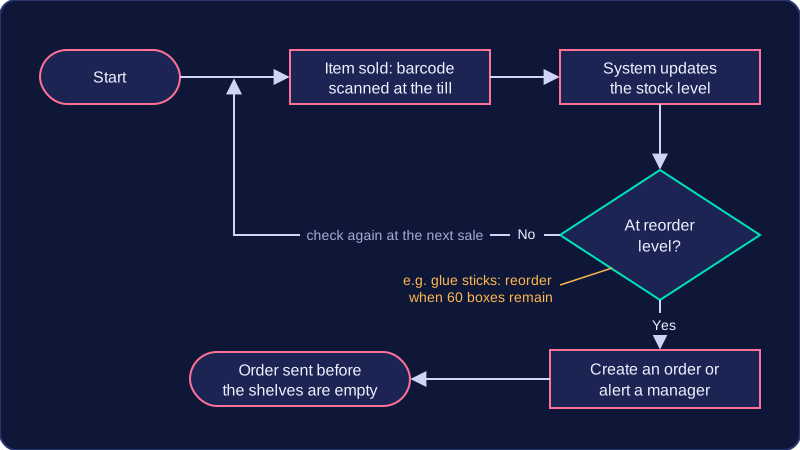
A computerised stock control system records stock levels each time an item is sold or used, such as when a barcode is scanned at a till. It applies the same principles as a bar gate stock graph: the business sets the levels and triggers that show when stock needs attention, and the system checks the stock level continuously.
When stock falls to the reorder level, the system can create an order automatically, or alert a manager to approve one. This reduces the chance of running out, cuts the time spent counting stock and gives managers up-to-date information for decisions. For example, a stationery supplier could set its system to reorder glue sticks when 60 boxes remain, so the order is sent before the shelves are empty.
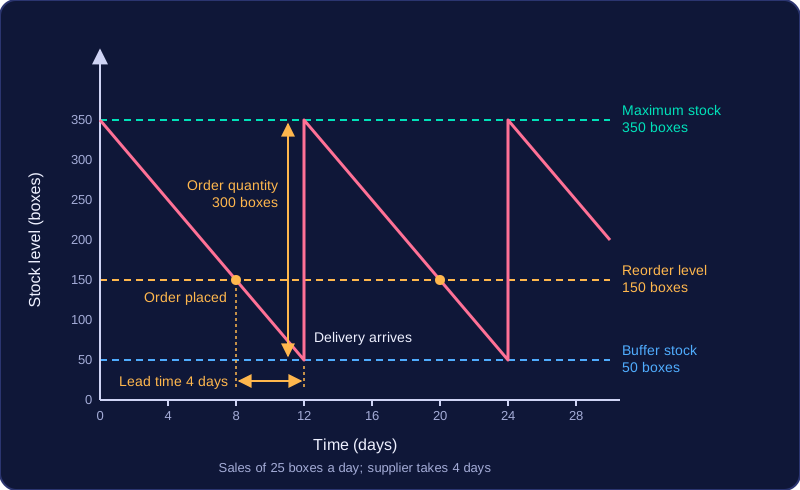
A bar gate stock graph shows how a business's stock level changes over time. Time runs along the bottom and stock level up the side. The line slopes down as stock is used or sold and jumps straight up when a delivery arrives, making a shape a little like a gate.
Reading the levels
- Maximum stock level: the most stock the business plans to hold, shown by the top of the vertical rise.
- Buffer stock (minimum stock level): emergency stock kept so the business does not run out. It is the level stock should not normally fall below.
- Reorder level: the stock level that triggers a new order. It must be set high enough that the delivery arrives before buffer stock is used.
- Lead time: the time from placing an order to receiving the delivery. On the graph it is the horizontal gap between reaching the reorder level and the vertical rise.
- Order quantity: the amount ordered, shown by the size of the vertical rise.
For example, a craft shop sells 25 boxes of card a day. It holds a maximum of 350 boxes, reorders at 150 boxes and keeps 50 boxes as buffer stock. Its supplier takes 4 days. When stock reaches 150, four days of sales use 100 boxes, so stock falls to 50 just as the delivery arrives. The shop orders 300 boxes, so the delivery raises stock back to its maximum of 350.
What it can show
A bar gate graph helps a business judge whether its reorder level and buffer stock are sensible. If no further delivery arrives, you can follow the downward slope to see when stock will run out. The graph usually assumes stock is used at a steady rate and deliveries arrive instantly. Real sales can be uneven and deliveries can be late, so the actual stock line may not be as neat.
Responding to stock problems means changing stock control when sales or deliveries differ from the plan. The aim is to keep enough stock to trade without holding far more than needed.
| Situation | What happens to stock | How the business may respond |
|---|---|---|
| Sales are higher than expected | Stock falls faster and may go below buffer stock, the safety minimum held. | Reorder sooner, increase the order size or review forecasts. |
| Sales are lower than expected | Stock stays high because it is being used or sold more slowly. | Delay orders, reduce order quantity or use promotions to reduce stock. |
| A supplier delays delivery | Lead time — the time from ordering to receiving — increases. | Set a higher reorder level, hold more buffer stock or use an alternative supplier. |
If sales are higher than expected, the business is using stock faster than planned. Ordering sooner or in larger amounts helps protect the buffer and reduces the chance of a stockout, where shelves or production lines have no stock. Reviewing forecasts helps the next order match demand more closely.
If sales are lower than expected, stock can build up. Delaying orders or cutting order quantity stops stock building up further, and a promotion such as a discount encourages customers to buy the slower stock.
If a supplier delays delivery, the gap between ordering and receiving grows. A higher reorder level makes the business order earlier, and more buffer stock gives it a safety margin. If delays continue, an alternative supplier may keep production or sales going.
A worked example
A garden centre sells bird feeders. A TV gardener features one of its feeders and sales are much higher than forecast. The manager reorders sooner and increases the order size, then reviews the forecast. When sales later slow, the centre delays its next delivery and runs a weekend promotion on feeders. If the feeder supplier then delays delivery, the centre raises its reorder level and keeps extra buffer stock until a second supplier can deliver.
Just in time (JIT) stock control means holding as little stock as possible and having supplies delivered only as they are needed for production or for sale. Stock arrives shortly before it is used, so hardly anything sits in a storeroom.
Why businesses use JIT
- Lower storage and warehousing costs: a smaller stockroom means less rent and insurance to pay, so fixed costs fall; there is also less handling.
- Better cash flow: less money is tied up in stock, leaving cash free for wages, bills or repaying borrowing.
- Less waste: stock held for months can be damaged, go out of date or become obsolete when tastes change.
- Matches stock to demand: supplies are ordered to match what customers are actually buying, so there is less unsold excess stock needing discounting.
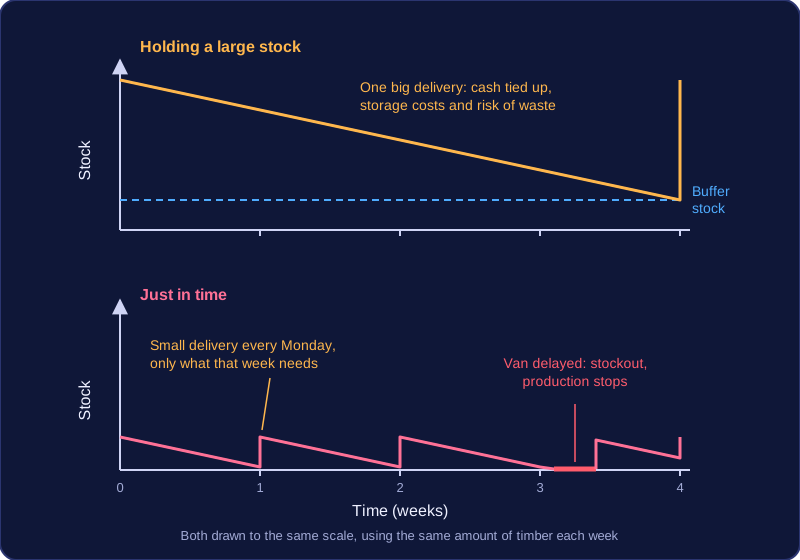
For example, a small workshop making wooden garden planters might take a timber delivery every Monday and hold only the timber it expects to use that week. The owner checks the order book first, so cash is not locked up in a pile of boards.
What JIT relies on
JIT only works with reliable suppliers, accurate demand forecasting, efficient logistics, good communication and trust between the business and its supplier. If a van is delayed, production can stop, the business suffers a stockout and customers may buy from a rival instead. JIT does not mean holding no stock at all: a small amount is still needed to keep work going.
The drawbacks
- Deliveries are frequent and in small quantities, which raises ordering and transport costs and can lose bulk-buying discounts and economies of scale, as larger orders usually cost less per unit.
- There is very little buffer stock, so any disruption to the supply chain hits the business quickly.
- JIT is unsuitable where demand is unpredictable, or where suppliers cannot be trusted to deliver on time.
Procurement is how a business finds suppliers and agrees terms for buying goods or services. It is more than buying stock: it means choosing and managing suppliers so the right goods arrive on the right terms.
Procurement aims to secure the best value goods or services and have them available on time. Best value means the right mix of cost, quality and reliability, not just the lowest price. Late or poor-quality supplies can disrupt production or sales, so procurement looks at the whole deal, not the headline price alone.
What procurement involves
Procurement includes selecting suppliers: comparing possible suppliers and choosing one that can meet the business's needs. The business then negotiates the main terms:
- Cost — what the business pays, including any discount for a larger order.
- Quality — the standard or specification the goods or services must meet.
- Delivery — how quickly and reliably supplies arrive, and the cost of delivery.
- Availability — whether the supplier can provide the quantities needed, including extra if demand rises.
- Payment terms — when payment is due, such as paying 30 days after delivery.
Negotiating these terms helps the business control costs and reduce the risk of delays or unsuitable supplies.
Supplier relationships
Building supplier relationships means communicating clearly, keeping promises and treating suppliers fairly. This builds trust: confidence that the supplier will keep its promises about quality, delivery and availability. A strong relationship can make a supplier more willing to help, such as fitting in an urgent order or warning the business early about a problem, reducing disruption and making problems easier to solve.
For example, a bike repair shop expecting a busy summer selects a supplier of brake cables. It agrees a lower cost for a bulk order, checks the cables meet safety standards, arranges delivery two weeks before the rush, confirms the supplier can send extra cables, and agrees to pay 30 days after delivery. Keeping in regular contact means the supplier warns the shop early if a delivery will be late, so the shop can order elsewhere.
When choosing a supplier, a business compares more than price. It looks at quality, delivery, availability, cost and trust.
Quality and trust
Quality means supplies meet the standard the business needs for production or sale. A joiner buying oak boards for shelves needs boards that are straight and dry. Warped or damp wood causes faulty shelves, wasted material, rework, returns and late orders, which can damage the joiner’s reputation. A business should aim for sufficient quality rather than always the highest: furniture-grade oak may cost much more than the job needs. The extra price only makes sense if customers will pay for it.
Trust means confidence that a supplier will keep promises about quality, delivery and availability. A trusted supplier is more likely to offer better terms, priority supply when stock is short, flexibility over order changes and fewer disputes.
Delivery and availability
Delivery includes delivery cost, delivery speed and delivery reliability. Reliable delivery means supplies arrive when promised. This matters greatly when a business uses just in time or keeps a small buffer stock, because a late delivery can stop production. Faster delivery often costs more, so speed and delivery cost must be balanced. Delivery cost also adds to the total cost of supplies.
Availability means the supplier can provide the quantities required when the business needs them. This is especially important for JIT and businesses with small buffer stocks, where a shortage can quickly stop work.
Cost
Cost is the price paid for supplies. A business seeks competitive prices, but should consider total cost and value, not just the headline price. The cheapest supplier may be poor quality, unreliable or unable to meet demand, so savings can be lost through waste, returns, delays and lost sales. For example, a bike repair shop may save £1 per brake cable from a cheap supplier, but if cables snap, refunds and fitting time cost far more.
Logistics is the management of the movement of goods. For a business it covers how materials and finished products travel from supplier to warehouse, from warehouse to shop or customer, and how they are stored and handled along the way. It is more than transport: choosing a courier, deciding how often deliveries arrive and planning storage space are all logistics decisions. A small business selling scented candles online, for example, must decide how often to have wax and glass jars delivered and which courier to use for customer orders.
Effect on costs
Logistics and supply decisions change costs in several ways: transport (how goods travel and how often), storage (warehouse or stockroom space, heating, insurance), stockholding (cash tied up in goods sitting still), waste (materials spoiling, breaking or going out of date), and delays and lost sales (orders that arrive late or cannot be met, which lose the business money). The candle seller who orders a large crate of jars once a month pays less per delivery but needs more storage space and risks breakages; ordering every week costs more in transport but frees up cash and space.
Effect on reputation and customer satisfaction
Customers judge a business on whether the product is available when they want it, whether its quality is consistent and how quickly it arrives. Late, poor-quality or unavailable supplies damage customer trust: someone who waits two weeks for a candle promised in three days may never order again. A reliable supplier, a sensible amount of stock and a courier that delivers on time protect reputation and keep customers satisfied.
The opposite is also true: a courier that loses or damages parcels may charge less per delivery, but refunds, replacement stock and lost customers usually cost more than the saving. Well-judged logistics and supply decisions can lower costs, improve reliability, protect reputation and raise customer satisfaction, while poor ones raise costs, cause delays and lose customers.
Business operations are the activities a business carries out to produce goods and provide services that satisfy consumer needs and wants. They turn inputs, such as materials or labour, into something a customer will pay for, and happen in every business, whether it sells physical items or provides a service.
Production is the process of making goods or providing services. Goods are physical things you can touch and own; services are activities carried out for a customer that you pay for but do not own. Both count as production: a workshop building a wooden bookcase is producing a good, and a mobile bike mechanic repairing a puncture is providing a service.
What affects the process a business chooses
A business can organise production in different ways, such as job, batch or flow production. Which suits it depends on four things:
| Factor | Why it matters |
|---|---|
| The product | The size, weight and nature of the item affect how it can be made and moved. Small, light items are easier to pass along a line than bulky or delicate ones. |
| Amount of customisation | If every customer wants something different, the same steps cannot be repeated exactly each time, so a flexible approach is needed. |
| Size of the market | Lots of customers wanting the same thing means production can be repeated. A small, specialist market keeps volumes low. |
| Skills and equipment required | Skilled craft work suits unique products, while expensive machinery is only worth buying when high volumes spread its cost. |
For example, a small firm printing names onto leavers' hoodies for local schools faces lots of customisation and a small market, so it makes each order separately. A firm making plain reusable water bottles sold in thousands of shops faces the opposite situation, so identical bottles can be made continuously and cheaply.
The choice matters because it affects how much each worker produces and how much each unit costs to make. Getting that right helps a business charge competitive prices and still make a profit.
Job production makes a single, one-off product designed around one customer's exact requirements. Each item is completed before work starts on the next, so the output is unique rather than a standard product made again and again.
Because every job is different, job production usually relies on highly skilled or specialist workers. A furniture maker building a fitted desk to a customer's measurements, for example, must measure, cut, shape and finish materials to suit that space. The business can be flexible and adapt the product to individual requirements, rather than forcing the customer to accept a standard size or design.
Varied tasks can also motivate workers, because they are not repeating the same small action all day. A craftsperson may enjoy seeing a whole product through from start to finish and using different skills on each job.
The trade-off is that job production usually has lower productivity and higher unit costs than batch or flow production. Workers spend time planning, setting up and solving problems for each individual item, so fewer units are made per worker per hour. Job production therefore suits low-volume, unique or highly customised output, such as a made-to-measure outfit or a one-off piece of stage scenery. It is not automatically poor quality; it can be skilled and carefully made, but it is slower and more expensive per unit than making standard items in larger quantities.
Batch production makes a group of similar goods — a batch — using the same machinery. A set quantity is produced, then the machinery is cleaned or reset so that a different batch can be made.
How a batch is made
A business chooses a batch size, such as 150 units, and runs the machinery until that quantity is complete. The equipment is then stopped, cleaned and set up again for the next batch, which could be a different size, colour or product. For example, a furniture workshop might run a batch of 150 oak chairs, then stop to reset its saws and jigs to produce 150 walnut chairs.
Why businesses use batch production
- It is faster than job production, because one run of the machinery turns out many similar items instead of a single one-off product.
- Workers repeat the same tasks, so less employee skill is usually needed than for individually made products.
- Output per worker is higher than in job production and unit costs are lower, because machinery and setup time are shared across the whole batch rather than one item.
- It allows some variety: each batch can be a different product, size or colour, which flow production cannot easily do because it makes a continuous run of identical items.
Drawbacks of batch production
Every changeover creates downtime — time when the machinery is being cleaned and reset and nothing is produced. That lost time lowers productivity and pushes up costs, so a batch producer cannot match the speed and low unit cost of a flow line, which carries on running without pausing to switch products. This is why productivity sits between job and flow production, and unit costs do too: lower than job production, but higher than flow production.
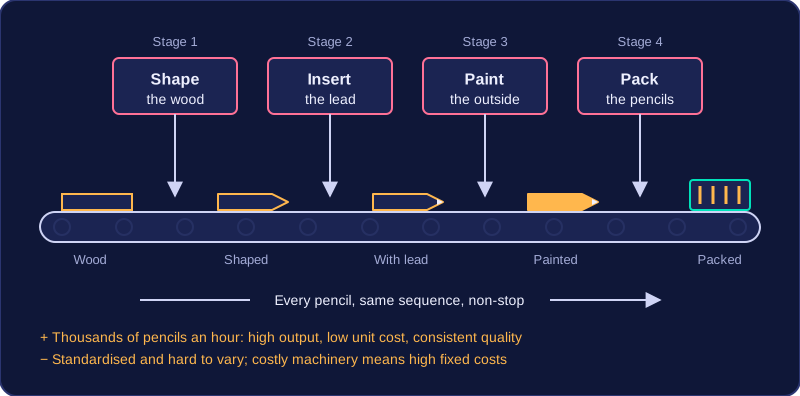
Flow production turns out large volumes of identical items by passing them continuously along a production line. Each item follows the same sequence of stages, with workers or machines repeating one task as the product moves along.
Why businesses use flow production
Flow production is usually automated or highly mechanised, so machines do most of the work. This gives high output and high productivity: a large number of identical items can be made in a short time with fewer workers needed for each item. Because every item goes through the same process, it gives a consistent standard of quality. The business can also spread its costs over many units, giving low unit costs per item. High volume means flow production can meet large-scale demand.
For example, a factory making identical wooden pencils could use a line that shapes the wood, inserts the lead, paints the outside and packs the pencils. Running continuously, the line makes thousands of pencils per hour, so each pencil carries a small share of the machine and labour costs.
Drawbacks of flow production
Flow production is less flexible. The product is standardised, so it is difficult to vary, and changing the design often means stopping the line and adjusting machinery. It also needs a large investment in machinery, which gives high fixed costs that must be paid even when sales are low. Automation can produce to a consistent standard, but it does not guarantee perfect quality: the machinery must be set up and checked correctly.
Productivity is how much output is produced per worker. It is often measured as output per worker per period, such as output per person per hour or per week, so it shows how efficiently labour is used to make goods or provide services.
Measuring productivity
Divide total output by the number of workers, or by the total hours worked. A garden bench workshop with four staff making 80 benches a week has productivity of 20 benches per worker per week. If those four staff work 160 hours in total, productivity is 0.5 benches per hour.
Productivity is not the same as total output. Making 200 benches with 10 staff may give the same productivity as making 80 with four staff, even though total output is much higher.
How productivity rises
Productivity increases when the same workers produce more output in the same time, or when the same output is produced with fewer resources. If the workshop makes 100 benches with four staff, productivity rises to 25 benches per worker. If it still makes 80 benches but with three staff, productivity has also risen, to about 26.7 benches per worker.
Why it matters for price and profit
Higher productivity helps keep unit costs down because wages and overheads are spread over more output. The business can set competitive prices and still protect its profit margin, the gap between price and cost per item. If it lowers prices to win customers, lower unit costs help stop that gap shrinking too much.
Automation means using machines and systems to carry out production tasks with little or no continuous human effort. Robotics is a form of automation where programmable machines perform physical tasks, such as moving, cutting or packing items. Once set up and switched on, they can keep working without a person operating them every second.
Improving quality
Automated equipment can improve quality because it repeats the same movement to a consistent standard. A machine set to cut panels to 40.0 cm will cut every panel to 40.0 cm, rather than one at 39.8 cm and the next at 40.3 cm. This gives greater accuracy and fewer human errors, such as a tired worker fitting a part the wrong way round. Quality still depends on the machine being programmed, checked and maintained correctly.
Improving or reducing flexibility
Technology can improve flexibility when it is reprogrammable. A business can change the machine's instructions so it switches quickly from making one product to another, or from one task to another, without buying new equipment. For example, a small furniture workshop could use a computer-controlled cutter to make chair parts in the morning and shelf parts in the afternoon by loading a different design file.
However, highly specialised technology may reduce flexibility. If a machine is built to perform only one task or make only one product, it cannot be switched to something else when demand changes. A machine that only attaches handles to a particular mug design is very efficient at that job, but useless if customers start asking for a different shape.
A trade-off means gaining more of one thing by accepting less of another. When a business chooses how to produce, it balances four aims: keeping costs low, raising productivity, improving quality and staying flexible enough to make different products. These aims can pull against each other, so managers choose the mix that best suits their market.
Automation and productivity
Investing in automation, such as robots, can raise productivity because machines work faster and for longer. It can also make quality more consistent, as each item is made the same way. However, automated equipment is expensive to buy and install, and a highly specialised machine may only make one product, which reduces flexibility. A garden bench maker that buys a robot welder gets more frames per hour and identical joints, but changing to a new bench design may need costly reprogramming or new tooling.
Flexibility and variety
More flexible technology lets a business offer greater variety. A laser cutter can cut many different shapes for personalised shop signs, so customers can order unusual designs. The trade-off is cost: flexible equipment often costs more per item than a specialised machine that repeats one job cheaply. A specialist press might stamp one bracket at a very low unit cost, while the laser cutter is slower and dearer to run but can make twenty different designs.
Quality and cost
Improved quality can reduce production costs. If fewer items are faulty, there is less waste, fewer errors to correct and less rework, saving materials, time and wages. For example, a pottery that checks each mug's glazing before firing can remove faulty ones, so it does not waste kiln energy on mugs it cannot sell.
| Change | Likely gain | Possible trade-off |
|---|---|---|
| More automation | Higher productivity and consistency | Large investment; less flexibility |
| More flexible technology | Greater product variety | Higher cost than specialised equipment |
| Better quality checks | Less waste, errors and rework | Extra checking time and cost |