Revision notes
Business Economics

Contents
The economic climate means the main economic factors that affect how fast the economy grows. It is an external influence: it comes from outside the business, so managers can only react to it. It has nothing to do with the weather; it means changes in things like the number of people in work, prices or borrowing costs.
Every business feels the economic climate, but not in the same way: a change that is good for one firm can be bad for another, depending on what it sells and who its customers are. The main factors are:
- Unemployment — people out of work
- Consumer income — how much households have to spend
- Inflation — the rate at which prices across the economy rise
- Interest rates — the cost of borrowing and the reward for saving
- Taxation — taxes the government takes, such as income tax and VAT
- Exchange rates — the value of the pound against other currencies
Each one affects either how much customers can spend or the business's costs and revenues, so each feeds through to demand, costs and profit.
Why the effect varies
Three things shape how hard a change hits: its extent (a small cost rise is easy to absorb; a large one may force prices up), its duration and whether it is temporary or long-term (a firm can ride out a few months of weaker sales, but years of change force decisions about prices, staffing and investment), and the type of business itself:
| Business | Effect of households having less to spend for several years | Why |
|---|---|---|
| Shop selling budget food | Sales hold up | Everyone needs to eat, and some customers trade down to cheaper items |
| Bouncy castle hire firm | Bookings dry up | Parties can be postponed or held at home |
| Factory exporting most of its output | Barely affected by UK households | Customers are overseas, so UK spending matters little |
Responding to changes in the economic climate means choosing actions when demand, costs, confidence or access to finance shift. Common responses include adjusting prices, marketing, stock and investment, because the same economic change can affect businesses differently.
In a downturn
When demand falls and confidence is weak, a business might cut costs by reducing energy use or renegotiating rent. It may delay expansion, reduce stock and focus on essential products. Value promotions and marketing that stresses low prices can protect sales. For example, a café might offer a cheaper lunch deal, while a bike shop holds fewer premium models and advertises repairs instead.
In an upturn
When demand rises, a business may invest in equipment, expand premises, recruit staff and increase stock. It may raise prices if demand is strong, but carefully, because competitors may not follow. A garden centre, for instance, could add a second till and take on weekend staff before spring.
Reacting to specific factors
Interest rates: higher rates make borrowing costlier, so a business may delay buying a new van, review prices to protect cash flow or chase unpaid invoices; lower rates may make investment more affordable.
Exchange rates: if the pound weakens, an importer pays more for foreign stock, so it may find a UK supplier, negotiate a lower price or raise its own prices. An exporter may gain because its goods look cheaper abroad.
Unemployment: if skilled workers are scarce, a business may raise wages or train existing staff. If unemployment rises, it may receive more applicants and recruit more easily.
Inflation: rising costs may lead a business to control expenses, negotiate with suppliers or increase prices gradually to avoid losing customers.
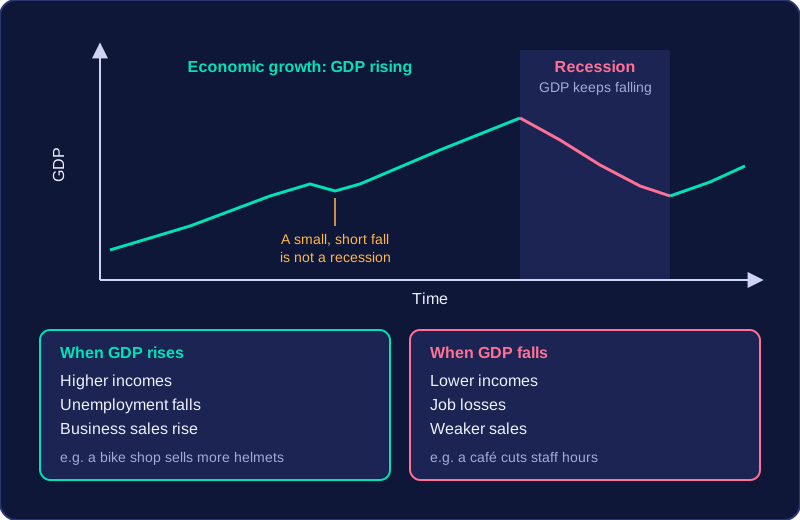
Gross domestic product (GDP) is the total value of all goods and services produced in an economy over a period of time, such as a year. It is used to measure economic growth, which is a rise in GDP over time. When GDP rises, the economy is growing because more is being produced and sold.
When GDP rises
Rising GDP usually brings higher incomes, because more people are in work and businesses are selling more. Unemployment tends to fall as firms take on staff to meet demand, and business sales rise as households have more money to spend. For example, a bike shop may sell more helmets and accessories when local wages are rising and more people are employed.
When GDP falls
Falling GDP usually means lower incomes, job losses and weaker sales. As households spend less, businesses earn less and may cut costs, including staff. A café might see fewer customers buying lunch during a downturn and reduce staff hours.
Recessions
A recession is a sustained period of falling GDP. It is not a single bad month or a small, short fall; the decline must continue over time. Recessions are hard for many businesses because demand falls. However, some can still do well: a business repairing washing machines may gain customers who choose to fix an old appliance rather than buy a new one, and a supplier of school uniforms keeps steady sales because families still have to buy them.
Unemployment is the number of people in an economy who are willing and able to work and actively looking for a job, but cannot find one. It measures joblessness across the whole country, not just staff losing their jobs at a single business.
When unemployment rises
With more people out of work, total consumer income usually falls. Households spend less, so demand for many products drops. For example, a soft play centre may find fewer families buying entry tickets and café meals. The fall is often bigger for non-essential products that customers can put off or cut out.
Recruitment can get easier. A business advertising a vacancy may receive more applications, fill the post faster and feel less pressure to offer large pay rises to attract workers. However, existing employees may feel less secure in their jobs. If they worry about being made redundant, their motivation and productivity can fall.
When unemployment falls
Falling unemployment usually means more people earning and spending, so demand rises. But suitable staff become harder to find, and a business may need to pay more or offer better conditions to recruit them.
It depends on the business
The effect is not the same for every firm. A labour-intensive business such as a childcare nursery, whose costs are mostly wages, is more exposed when it must pay more to attract staff, because pay makes up such a large share of what it spends. A business with heavy fixed costs, such as a ten-pin bowling alley paying rent, insurance and business rates on a large building, cannot respond quickly by cutting those costs when demand falls, so its profit falls quickly if fewer customers come through the door.
Consumer income is the money people receive from work or from investments, such as wages, salaries and interest on savings. Disposable income is what is left after tax and other deductions such as National Insurance and pension contributions. It is the money consumers actually have available to spend or save, so it matters more to businesses than income before deductions.
When incomes rise
Rising consumer income usually increases demand, especially for non-essential goods and services such as meals out, holidays and designer clothes. With more spare money, households can afford extras they previously went without. Higher demand can also encourage new businesses to enter the market, because owners expect more customers to be able to afford their products. For example, if a large employer opens a well-paid site in a small town, a café may sell far more lunches, and a rival café may decide the area is now worth opening in.
When incomes fall
Falling consumer income usually reduces demand and may make consumers switch to cheaper alternatives. A family might swap branded cereal for a supermarket own-brand or cancel a streaming subscription. This switching to cheaper options is called trading down.
The type of business matters
The effect on a particular business depends on what it sells. A shop selling essentials, such as a budget supermarket or a value pharmacy, may be less affected than one selling luxury products. It may even gain customers as people trade down to cheaper brands. A business selling big-ticket discretionary products, such as custom-built garden offices or hot tubs, could lose orders quickly when incomes fall, because customers can delay or cancel a purchase they do not really need.
Inflation is a sustained increase in the general price level over time. It does not mean one product has become more expensive; it means prices are rising across the economy as a whole. The rate is usually shown as a percentage per year.
Why it matters to businesses
Rising inflation pushes up the cost of business inputs such as materials, energy and wages. To protect profit, a business may raise its selling prices, but that can deter customers.
Inflation also reduces the real value of consumer income when wages do not rise at the same rate. If your pay goes up by 2% while prices rise by 6%, you can buy less. Households often cut back on non-essential goods first, so demand for treats and luxuries may fall.
High inflation can make UK exports less competitive if UK prices rise faster than prices in other countries. Foreign buyers may switch to cheaper alternatives from elsewhere.
Hyperinflation
Hyperinflation is a very high and accelerating rate of inflation. Prices can change so quickly that businesses struggle to plan costs and set prices, which makes trading very difficult.
For example, Bramble Bikes imports gears and sells some bikes abroad. Inflation of 5% raises its component and wage costs, so it increases its prices by 5%. Its UK customers' wages rise by only 2%, so their real income falls and sales of its premium range drop. Rivals based abroad face lower inflation, so overseas buyers find Bramble's bikes more expensive and export orders fall.
An interest rate is the price paid for borrowing money and the reward received for saving. It is charged as a percentage, so 5% interest on a £20,000 loan costs £1,000 a year on top of repaying the money borrowed.
Rising interest rates
When rates go up, borrowing costs more. A business repaying a loan or overdraft hands over more interest each month, leaving less cash for everything else. Investment is often the first thing to suffer: new equipment, extra premises or a bigger delivery van may be postponed because the project now has to earn enough to cover dearer finance. For example, a garden centre borrowing £60,000 to build a café would pay £2,400 a year in interest at 4%, but £4,200 at 7% — an extra £1,800 that might persuade the owners to wait.
Customers are affected too. Higher repayments on mortgages, car finance and credit cards leave households with less disposable income, so they spend less, especially on non-essential goods and services. Lower demand means lower sales and possibly lower profit for the businesses selling to them.
Falling interest rates
Cheaper borrowing works the other way. Businesses are more willing to fund investment, and consumers may take out loans and spend more, which can raise demand. Falling rates are not automatically good news for everyone, though: savers earn less interest, so customers living on savings income may cut back.
Why the effect varies
A rise in rates can even help a business whose customers are savers with money in the bank, because they receive more interest and may have more to spend. The overall impact depends on how much the business itself borrows, how much its customers borrow, and whether those customers are mainly savers or borrowers.
Taxation is a charge imposed by the government on individuals and businesses to raise money for government spending, such as schools, hospitals and roads. A change in tax rates is an external influence: the business does not decide it, but it can change how much customers have to spend and how much profit a business keeps.
The main taxes
| Tax | Charged on | Who it hits first |
|---|---|---|
| Income tax | Earnings from work | Employees, whose take-home pay falls |
| Corporation tax | Business profits | The business, which keeps less of what it earns |
| VAT | The sale of goods and services | Customers, who pay more at the till |
Income tax and VAT both affect customers. If income tax rises, a worker's pay packet shrinks, so their disposable income – the money left after tax and other deductions – falls. A rise in VAT works differently: it pushes up prices in shops, so the same disposable income buys less. Either way, customers have less to spend and demand for businesses' products can fall.
For example, a scooter shop selling models at about £150 may find that customers whose pay has dropped by £25 a month put off buying a new scooter until later.
Effects on the business
Rising corporation tax works differently. It takes a bigger share of profit, so the business keeps less retained profit – the profit left inside the business after tax. A print firm earning £70,000 profit might lose an extra £2,100 if the rate rises by 3p in the pound, which could mean delaying a new printer. Less money for investment can slow growth.
Falling taxation does the opposite. Lower income tax leaves customers with more disposable income, and lower VAT means that income buys more, so demand may rise. Lower corporation tax leaves more retained profit, which can pay for equipment, staff or new premises, allowing the business to grow.
Whether a tax change helps or harms a business depends on which tax has changed and on its customers, its costs and how much profit it makes.
An exchange rate is the price of one currency when it is swapped for another. For example, if £1 buys 1.35 Swiss francs, that is the exchange rate between the pound and the Swiss franc. It is not the price of a product abroad; it is the amount of another currency that one unit of currency will buy.
Appreciation and depreciation
When a currency rises in value, this is appreciation. A UK business buying imports finds them cheaper, because each pound buys more foreign currency. However, UK exports become more expensive for foreign buyers, because they need more of their own currency to buy pounds.
When a currency falls in value, this is depreciation. Imports become more expensive for UK businesses, while UK exports become cheaper for foreign buyers.
| Change | Imports for UK businesses | UK exports abroad | Foreign imports competing in the UK |
|---|---|---|---|
| Appreciation | Cheaper | More expensive for foreign buyers | Become cheaper, so competition increases |
| Depreciation | More expensive | Cheaper for foreign buyers | Become dearer, so competition may reduce |
Exchange rate changes affect businesses that import raw materials, export goods or face competition from foreign imports. A business importing materials may gain from appreciation because its costs fall, but an exporter may lose sales as its products look dearer abroad. Depreciation can help exporters and UK firms competing against imports, but it raises costs for importers.
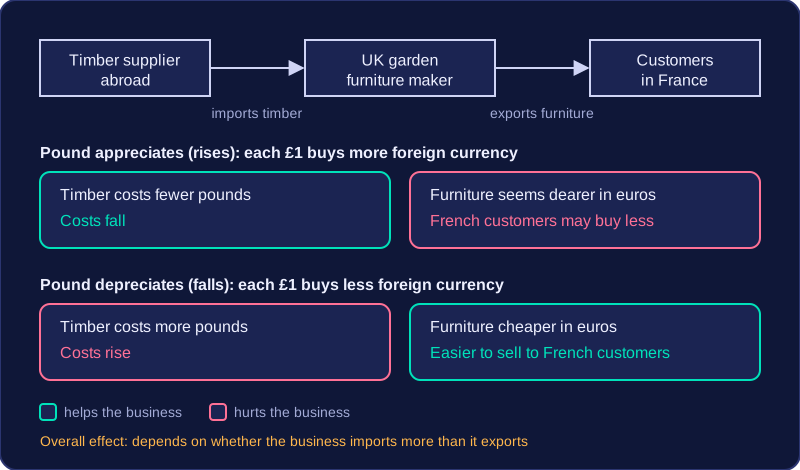
Worked example
A UK garden furniture maker buys timber from abroad and sells some furniture to customers in France. If the pound appreciates, the timber costs fewer pounds, which reduces costs, but French customers may buy less because the furniture now seems more expensive in euros. If the pound depreciates, the timber costs more, but the furniture becomes cheaper for French customers. The overall effect depends on whether the business imports more than it exports, or the other way round.