Business Economics
Economic growth and recession

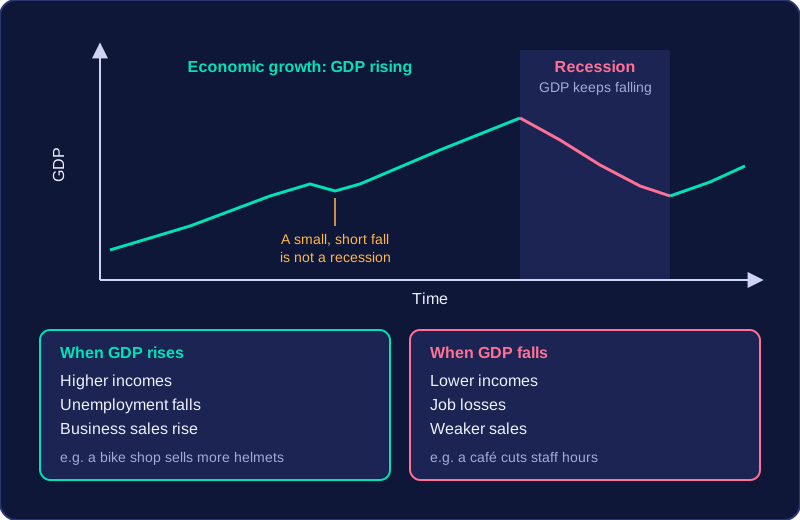
Gross domestic product (GDP) is the total value of all goods and services produced in an economy over a period of time, such as a year. It is used to measure economic growth, which is a rise in GDP over time. When GDP rises, the economy is growing because more is being produced and sold.
When GDP rises
Rising GDP usually brings higher incomes, because more people are in work and businesses are selling more. Unemployment tends to fall as firms take on staff to meet demand, and business sales rise as households have more money to spend. For example, a bike shop may sell more helmets and accessories when local wages are rising and more people are employed.
When GDP falls
Falling GDP usually means lower incomes, job losses and weaker sales. As households spend less, businesses earn less and may cut costs, including staff. A café might see fewer customers buying lunch during a downturn and reduce staff hours.
Recessions
A recession is a sustained period of falling GDP. It is not a single bad month or a small, short fall; the decline must continue over time. Recessions are hard for many businesses because demand falls. However, some can still do well: a business repairing washing machines may gain customers who choose to fix an old appliance rather than buy a new one, and a supplier of school uniforms keeps steady sales because families still have to buy them.
Practise this
Edexcel GCSE Business · 1.5.4 The economy and business