Revision notes
Impact of Modern Technologies
How modern technologies change the way organisations work: modern teams, communicating with stakeholders, inclusivity and accessibility, and the impacts on organisations and individuals.

Contents
- Technology and productivity
- Remote working
- Costs of using technology
- Technology in business
- Responding to changes in technology
- Social media
- Social media risks and limitations
- Digital communication
- Drawbacks of digital communication
- Electronic payment systems
- Drawbacks of electronic payments
- Technology and competitiveness
Technology can reduce a business's costs by helping it work more efficiently and raising its productivity. Efficiency means getting more from the resources used, with less waste. Productivity is the amount produced per worker, or per hour; for example, the number of customers served by one member of staff in an hour. With better technology, a business can produce more, or serve more customers, using the same resources.
How average costs fall
Average cost is total cost divided by output, such as the cost per meal or per customer. Some costs, like rent, equipment and salaries, do not rise just because output rises. If technology lets the same team serve 150 customers instead of 100, those fixed costs are spread over more sales, so the average cost per customer falls.
Technology can also cut waste. A gardening business with two vans that uses route-planning software may travel fewer miles between jobs. Fuel and time are saved while the same number of gardens is still tended, so each job costs less to deliver.
Worked example
A bakery pays £900 a day in fixed costs and employs three people. A new dough divider lets it make 600 loaves a day instead of 400, with no extra staff. Fixed cost per loaf falls from £2.25 (£900 ÷ 400) to £1.50 (£900 ÷ 600). The bakery has produced more with the same resources, so its average fixed cost per loaf is lower. If the machine's own cost is less than these savings, its average total cost per loaf will also fall.
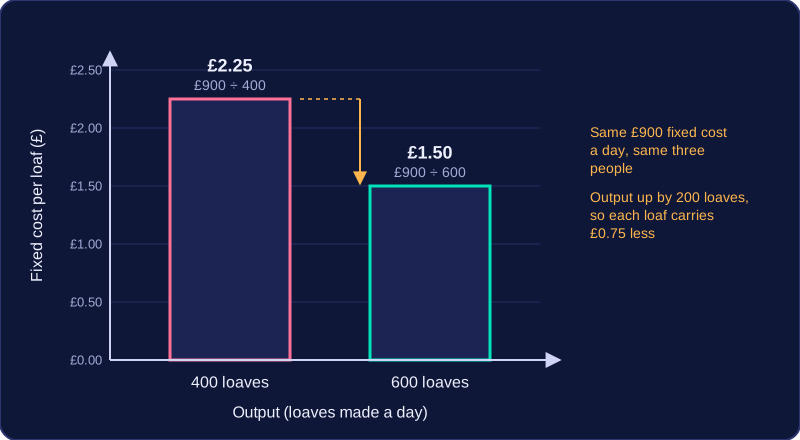
The saving depends on using the technology well and on the task suiting it; simply buying new equipment does not guarantee lower costs.
Technology has changed ways of working by enabling automation, such as machines completing repetitive tasks, faster communication, flexible working and collaboration across locations. Remote working means employees work away from the workplace, using technology such as laptops, cloud storage and video calls to stay connected. For example, a small online bookseller might let its customer support team answer emails from home.
For the business
Remote working can lower office costs because fewer desks, rooms and utility bills are needed. It can also widen the labour pool, since people who live too far away to commute can still be hired, and flexible arrangements may help retain staff.
But there are drawbacks. Communication can be harder when quick questions are not answered face to face, and teamwork and creativity may suffer because people do not share ideas spontaneously. Supervision may be reduced, so managers must rely on targets and check-ins, and some staff may feel isolated. The business may need to pay for equipment such as laptops, and for security software. Productivity can also fall if home distractions or poor internet get in the way.
For employees
As an employee, you can benefit from flexibility and from reduced commuting time and cost. However, remote working can cause isolation and blur work-life boundaries, making it hard to switch off when the workplace is also the kitchen table.
The impact depends on the business, the job role and how well the technology is managed. A data-entry role may suit remote work, while a team that plans advertising campaigns may need regular video meetings and shared online boards to keep ideas flowing.
Using technology can raise a business's costs, even if it later makes the business more efficient. The money is often spent before any benefit arrives.
Set-up and running costs
Buying and installing systems costs money. You might need laptops, tablets, card readers or a new till, and then pay someone to set up the software, connect devices and move old records across. After that, maintenance is needed: equipment breaks, software needs updating and faults must be fixed, sometimes by paid IT support.
Staff training can add another cost. Employees need time away from serving customers to learn the system, and you may pay for a trainer or for staff wages during training. Training is important because poorly trained staff make errors, but it still uses money and time.
Cyber security also costs money. A business may buy antivirus software, set up firewalls and backups, or pay for security advice. It may also take out insurance to cover losses if something goes wrong. These measures protect customer data and sales, but they are extra spending created by using technology.
Ongoing subscriptions
Many software and services are paid for by subscription, such as a monthly fee for accounting software, cloud storage, website hosting or an online booking system. These payments continue for as long as the business uses the service, so they add to regular overheads rather than being a one-off purchase.
For example, a garden centre installing tablets for its café tills might spend £2,000 on devices, £500 on installation, £60 a month on till software, £350 on training and £400 a year on cyber security. The technology may speed up service, but these costs must be covered before it adds to profit.
Technology in business means the digital tools and systems a business uses to carry out its activities, such as selling to customers, communicating with people inside and outside the firm, and taking payments. It covers everything from a website that takes orders to a messaging app a manager uses to brief staff.
The four main types
Each type supports a different activity, and most businesses use a mix of them.
| Type | What it does | Example |
|---|---|---|
| E-commerce | Buying and selling goods or services online, through a business's own website or an online marketplace | A candle maker in Sheffield lists her wax melts on her own site and takes orders from customers in other countries |
| Social media | Platforms where users create and share content, used by businesses to reach customers, answer questions and hear opinions | A bike repair shop posts photos of finished repairs and replies to comments underneath |
| Digital communication | Exchanging messages or information electronically, for example by email, video call or instant message | A small catering firm video-calls a supplier in another city to confirm an order |
| Electronic payment systems | Taking and making payments without cash, using cards, phones or online transfers | A market stall takes contactless card payments as well as cash |
The four types overlap in practice. A business that sells online still needs a way to take payment, and it may use social media to send customers towards its shop. Having a website or running adverts online is not e-commerce on its own: e-commerce means customers actually buy and pay for goods or services online.
Spotting which type a case is about matters, because each one does a different job: e-commerce completes a sale, social media builds a relationship with customers, digital communication shares information between people, and payment systems move the money. A single customer might see a post from a bakery, order a cake through its website and pay by phone, so the bakery uses three of the four types to make one sale.
Technology change means new or improved digital tools, systems and processes used in business. It affects how a business produces, markets, sells and communicates, and it is not only about new gadgets: new software and new ways of competing matter too. A business can respond by adopting or upgrading technology to keep up with what customers and rivals are doing.
How businesses respond
- Build digital skills: train current staff or recruit people with technical skills, so new systems are used safely and productively.
- Change products or services: add features customers now expect, such as online booking, click-and-collect or a mobile app for loyalty points.
- Use digital marketing and e-commerce: sell through a website and reach customers on social media, which can widen the customer base and help the business compete.
- Improve efficiency: software and automation can cut waste and costs, but usually need investment and can change job roles, so staff may need retraining.
- Review security: more online trading means more personal and payment data is held, so a business should check passwords, backups and who can access records, and keep customer details safe.
New rivals and obsolete products
Technology can lower barriers to entry — the obstacles that make it hard to start in a market. An online shop can be launched with a website and social media rather than an expensive high-street store, so new competitors may appear. Existing businesses may respond by improving their own online service or offering something distinct. Technology can also make a product or way of working obsolete, meaning out of date and no longer wanted. A business then has to adapt or replace it, or it may lose sales.
Worked example
A family-run bicycle shop finds that a new online-only cycle retailer can undercut it and deliver anywhere in the country. It responds by adding a repair-booking service to its website and taking contactless payment in store, posting short maintenance videos on social media, training one member of staff to handle online orders, and tightening security for customer details. These responses cost money, but they help it keep customers and compete.
Social media is technology that lets users create and share content — posts, photos, videos, reviews — and take part in social networking by connecting with other users and responding to what they share. For a business, it is more than an online poster: customers can reply, ask questions and post their own opinions, and everyone else can see those replies.
Talking to customers in both directions
Traditional advertising mostly sends a message outwards. Social media allows two-way communication: a customer posts a query and the business answers, and a customer leaves feedback that the business can read and act on. For example, a bakery posts a photo of a new loaf; a customer asks whether it contains dairy, and the baker replies within the hour. Because the answer is public, one reply helps many other customers at the same time.
Researching what customers want
Much of what customers post is useful information. By reading comments, reviews, polls and the questions people keep asking, a business can learn about customer needs and preferences — which flavours, sizes, colours or opening hours are wanted. A bicycle repair shop that is repeatedly asked for weekend drop-offs has found out something a survey might have missed, and can adjust what it offers.
Better service, more returning customers
Replying quickly and acting on feedback improves customer service. Think about a customer whose problem is sorted out in public: they are more likely to trust the business and buy again, and their positive comments may persuade new customers to give it a try. That can lift sales without the business paying for advertising space, because the conversation itself does the persuading.
Social media lets a business share posts and communicate publicly with customers, but it can also expose the business to risks. A complaint or critical comment is visible to everyone, not just the person who wrote it.
When negative comments spread
Negative comments can be shared, screenshotted and spread quickly to people who were never customers. If a bike repair service is accused of returning a bike late, the post may be passed around local cycling groups. Future customers may choose another shop, so the business can lose sales as well as its reputation. Fast replies and fixing the problem can reduce the harm, but the business cannot control what others share.
Time, skills and paid reach
Using social media well is not free in practice. Someone must plan posts, reply to messages and check comments, which takes time away from other work. Posts also need skills: poor spelling, an aggressive reply or a joke taken the wrong way can damage the business. Free posts may reach only a small number of people, so a business may pay for advertising to show posts to more customers. That adds to costs and does not guarantee sales.
Matching the platform to customers
Social media is only useful if the target customers use that platform. A skateboard shop aimed at teenagers might reach buyers through a short-video app, while a garden centre aimed at older local residents might do better with a local community group online or a printed newsletter. Effort on the wrong platform can use time and money with little return. Some customers avoid social media completely, so it should not be the only way a business communicates.
Digital communication is the electronic exchange of messages or information. It covers anything sent as data rather than on paper or face to face, such as email, instant messaging, video calls and documents that several people edit online at the same time.
Faster communication
A message can reach a colleague, supplier or customer in seconds, so decisions happen the same day instead of waiting for a letter or a return phone call. A small joinery firm can email a quote to a customer in the morning and have the job confirmed by the afternoon, so the work is booked in and the money comes in sooner. Quick answers also sort out problems before they grow, such as a café emailing its supplier about a short delivery while the driver is still nearby.
Working together from different places
People who work in different branches, from home or in different countries can still work as a team. Files stored online can be viewed and updated by everyone, video calls let a group talk face to face on screen, and messages can be read when each person is free, which matters when colleagues are in different time zones. For example, a furniture workshop in Leeds can discuss a design with a fabric supplier overseas without either person leaving their workplace.
Lower communication and travel costs
Email and messaging apps usually cost nothing extra to send beyond the internet connection the business already pays for, so less is spent on printing, postage and paper. Video calls replace some journeys altogether, saving fares, fuel and hotels, plus the wages paid for hours staff would otherwise spend travelling. A garden design business that meets a client by video call instead of driving two hours each way saves the fuel and gains several hours of paid work.
Digital communication can create problems that a face-to-face conversation usually avoids. Messages sent by email, chat or messaging apps carry less tone of voice, body language and facial expression, so they are easier to misread.
Less personal, more misunderstanding
A short message can sound blunt even when the sender is being friendly. Imagine a café owner replies to a supplier with ‘Fine. Send the usual order.’ The supplier might think the owner is annoyed and delay the order while checking, which wastes time. Misunderstanding happens because digital messages are less personal: you cannot see a smile, hear a warm tone or clear up confusion immediately.
Dependence on technology
Digital communication depends on reliable technology and internet access. If the broadband drops, a laptop fails or a messaging service goes down, staff may be unable to read or answer messages. A small bike repair shop taking bookings by online chat could lose customers during an outage, because people cannot ask about repairs and may go to another shop.
Overload and pressure
Many channels can create information overload: a catering team might receive orders by email, website form and phone app, so important details get buried. There can also be pressure to respond quickly. Staff may feel they must answer every message at once, even in the evening, which can cause stress and rushed replies. A rushed reply can contain the wrong delivery date, leading to wasted food or an unhappy customer.
Electronic payment systems are ways of paying for goods or services without using cash. The customer pays by card, phone or online, and the money is transferred electronically from their bank account to the business's. For example, you can tap a debit card on a reader at a garden centre or pay by card at a website checkout.
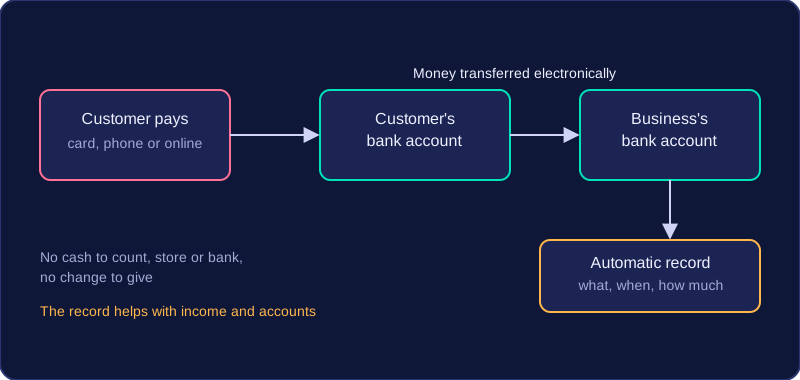
Electronic payments are quick and convenient for customers. A payment can be made in seconds, so customers do not need to find the right change or wait while cash is counted. This can make a business more attractive, especially when customers are in a hurry, and shorter queues mean staff can serve more people.
For businesses, electronic payments can reduce the costs and risks of handling cash. There is less need to count, store and bank notes and coins, and less risk of theft or of staff giving the wrong change. A mobile coffee van, for instance, can take card payments and avoid carrying a large float (the cash kept for giving change).
Each electronic payment creates an automatic record of the transaction. This helps with record-keeping because the business has a clear list of what was sold, when and for how much. That makes it easier to track income and prepare accounts, and it reduces paperwork.
Electronic payments also make it possible to sell to customers the business never meets. A small furniture maker could take a card payment from someone visiting the workshop and also sell a shelf online to a customer in another city. The business is not limited to customers who can visit and pay with cash.
Reducing paperwork and cash handling also cuts costs: less admin time means staff can spend more time on tasks such as serving customers.
Electronic payment systems let customers pay by card, phone or online, but they can raise a business's costs, reduce its sales or put customer data at risk.
Transaction fees
Each electronic payment usually carries a transaction fee paid to the payment provider. This is often a small percentage of the sale plus a few pence, so the fee takes a bigger share of a low-value sale than of a large one. For example, a florist charging £2.50 for a bunch of daffodils might pay about 25p in fees, which is 10% of the price. Across hundreds of sales a week, these fees add up to a real cost that reduces profit.
System failures and cash customers
Electronic payments depend on working equipment and a reliable internet connection. If a card machine freezes or the provider has an outage, the business cannot take payment, queues build and customers may leave without buying. A business that refuses cash may also lose shoppers who prefer notes and coins or who have no card or smartphone. A mobile dog groomer who only accepts card could lose a regular customer who always pays in cash.
Fraud and cyber security
Taking payments electronically raises the risk of fraud, such as stolen card details being used to buy goods, and of cyber attacks that could expose customer data. The business may then need to spend more on security software, staff training, insurance and refunds. Fees, lost sales and security costs all push up costs, so electronic payments are rarely free for the business.
| Drawback | Why it happens | Effect on the business |
|---|---|---|
| Transaction fees | A percentage and fixed charge is taken from each sale | Lower profit on every item sold |
| System failure | Equipment, internet or provider outages | Sales lost and customers go elsewhere |
| Cash customers | Some people prefer cash or lack a suitable card | Lost sales if cash is refused |
| Fraud and cyber risk | Fraudsters target card details and business data | Security costs, refunds and damaged trust |
Technology can change what customers expect from every business. If a rival lets people order in seconds through an app, track a delivery or pay with a tap, customers begin to see that convenience and speed as normal. A slower business then feels frustrating, even if its product is good.
Adapting to stay competitive
Competitiveness means being able to keep and win customers against rivals. To protect sales, a business may need to change how it uses technology and adjust its marketing mix — its product, price, place and promotion — so the whole offer still appeals. For example, Riverside Pet Supplies is a small shop whose customers now check stock on their phones before travelling. It adds live stock levels, click-and-collect slots and card payments, then promotes the service to local pet owners online. This makes buying quicker and more convenient, so it can keep customers who might otherwise use a larger competitor.
Opportunity and threat
Technology creates opportunities. It can raise sales because a business can reach more customers and answer their questions faster, and it can lower costs by automating routine tasks, such as sending order confirmations. It also creates threats. A competitor can use the same technology to offer lower prices or faster service, and customers can compare and switch in minutes. Customer behaviour changes too, but not everyone adopts every tool; some still prefer a phone call or a face-to-face conversation, so removing every traditional option can lose sales. The competitive risk is standing still while rivals make buying easier.
- Section 1Changes to Modern TeamsWorld TeamsDiversity in Teams24/7/365 WorkingOffice-Based WorkingPermanent and Casual Staff7 notes 11 min readStart reading
- Section 2Managing Modern TeamsBenefits of CollaborationCollaboration ToolsLive Chat and Direct MessagingVideo ConferencingEmail for Team Communication8 notes 9 min readStart reading
- Section 3Communication with StakeholdersStakeholdersCommunication Platforms and ChannelsPrivate and Public Communication ChannelsWebsites for CommunicationSocial Media for Communication9 notes 12 min readStart reading
- Section 4AccessibilityInclusivity and AccessibilityLayout DesignLayout Faults and ImprovementsFont SelectionColour Selection11 notes 15 min readStart reading
- Section 5Impacts of Modern Technology on OrganisationsInfrastructure for Modern TechnologyCommunication TechnologiesLocal and Web-Based Platforms24/7 Access and Online SellingDispersed and Distributed Data6 notes 10 min readStart reading
- Section 6Impacts of Modern Technology on IndividualsImpacts on IndividualsReduced CommutingRemote Working DrawbacksConnection and IsolationSelf-Confidence and Technology6 notes 10 min readStart reading