Wired and Wireless Networks
Wired Connections and Ethernet
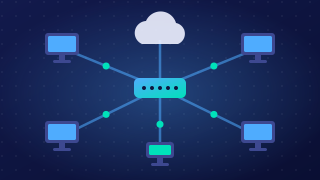
In a local area network (LAN), a wired connection uses Ethernet. Ethernet is a family of standards for wired local area networks, and it is a widely used standard for joining devices together with cables in a LAN.
A family of standards, not a cable
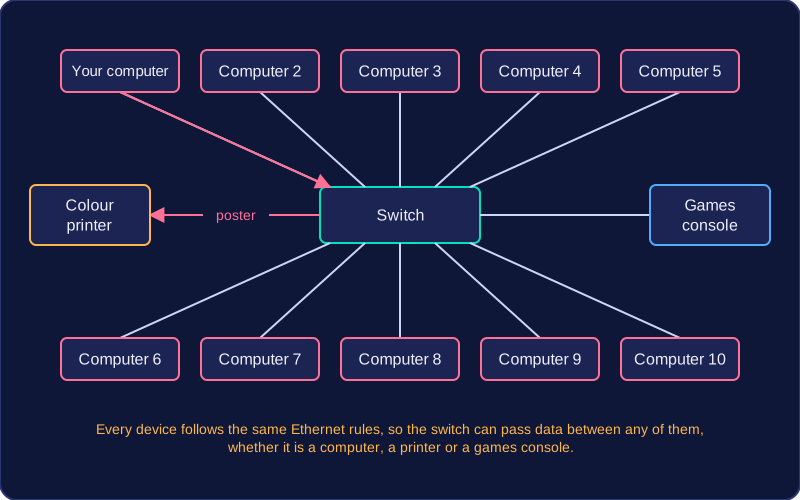
Ethernet is not one particular cable, and it is not a wireless connection. It is a set of agreed rules covering things such as how signals are sent along a cable, what the connectors look like and how fast data can travel. Different manufacturers build equipment that follows these same rules, so a device made by one company can be connected to equipment made by another without extra adapters.
The cable is simply the physical path the data travels along; Ethernet is the agreed set of rules for using it. The standard is the rules themselves, not any one device built to follow them, so saying a network is "Ethernet" tells you how the devices communicate, not which single cable has been used.
Using cables instead of radio waves
Ethernet carries data along cables rather than through the air using radio waves. For example, in a small bike repair shop, the till, the back-office computer and the label printer could each be joined by Ethernet cables to the same network. When a customer pays at the till, the sale is recorded on the back-office computer because the data travels along those cables.
Because the connection is fixed, a device using Ethernet usually stays in one place, but it does not depend on a radio signal reaching it. That use of cables is why wired connections are described separately from wireless ones such as Wi-Fi and Bluetooth.
Practise this
OCR GCSE Computer Science · Wired and Wireless Networks