The Internet
Domain Name Service DNS
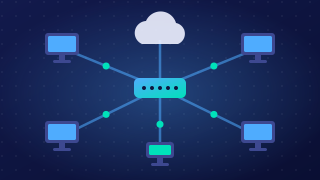
DNS (Domain Name Service) is a service made up of many Domain Name Servers. It takes the domain name from a URL and works out the IP address of the server where the website is stored.
Every device connected to the Internet has its own IP address, and that includes every web server: the address is how the device is identified on the network. A URL (Uniform Resource Locator) gives the location of a particular web page or resource, and the domain name part of it identifies the web server that holds the website. For example, in https://www.rocketkites.co.uk/events, the domain name is www.rocketkites.co.uk.
People use domain names in URLs because IP addresses are long strings of numbers that are difficult to remember and type accurately. If you had to type the IP address of a web server instead, one wrong digit could send you to the wrong server or to nothing at all.
Looking up an IP address
When your browser needs a page, it sends the domain name from the URL to a DNS server. The DNS server looks the name up in its database of domain names and matching IP addresses, then returns the IP address to your browser. Your browser can then contact the web server at that address.
Many Domain Name Servers are used because one server could never hold a copy of every domain name, nor cope with all the requests made across the Internet, so the work is shared out. Using many servers also means that if one DNS server fails, the others can still answer requests.
DNS servers are not web servers
A DNS server stores a database of names and IP addresses, not the website's pages. The web server is the computer that stores the pages and sends them to your browser. So DNS helps you find the right web server; it does not hold the website itself.