Network Performance
Bandwidth Sharing
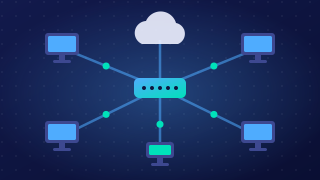
Bandwidth sharing happens because a connection's bandwidth is not given separately to every device. It is a shared amount of data capacity, divided between all the devices using that connection at the same time.
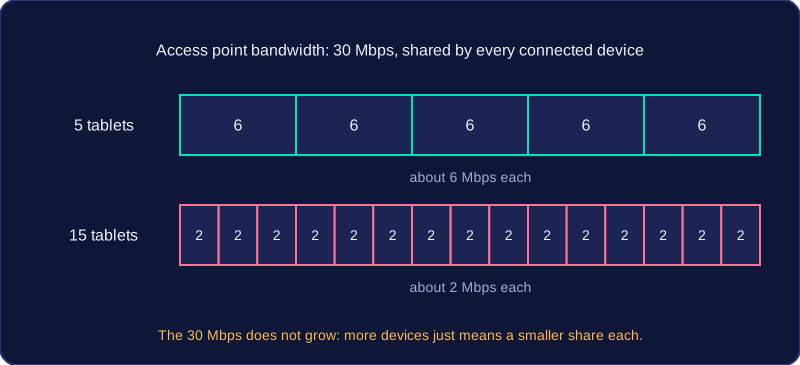
To find one device's share when all of them are busy, divide the total bandwidth by the number of devices active at that moment. For example, an art room has a 240 Mbps connection and 30 tablets downloading images together. Each tablet gets about 240 ÷ 30 = 8 Mbps. If 10 more tablets start downloading, each of the 40 tablets gets about 240 ÷ 40 = 6 Mbps. The total bandwidth has not changed, but every device's share is smaller.
More active devices, more congestion
As more devices send and receive data at once, more traffic is created. This congestion means each device gets a smaller share of the bandwidth, so the network's performance falls and work on the network takes longer to finish. Performance falls most when many devices are busy at the same time; a device that is connected but idle uses very little bandwidth, so it hardly affects the share.
Heavy users take a bigger share
A few users can also slow everyone else. If two students in the music room are uploading long audio recordings to the school's shared drive while the rest of the class is researching online, those heavy transfers take a large slice of the shared bandwidth. The other devices are left with less capacity, so their work slows down even though only a handful of devices are connected.