Sound
Bit depth
Bit depth is the number of bits used to store each sample of a digital sound, so a recording is described as 8-bit or 16-bit. When the amplitude of a sound wave is measured, the value is stored as a binary number, and the bit depth tells you how many bits long that number is.
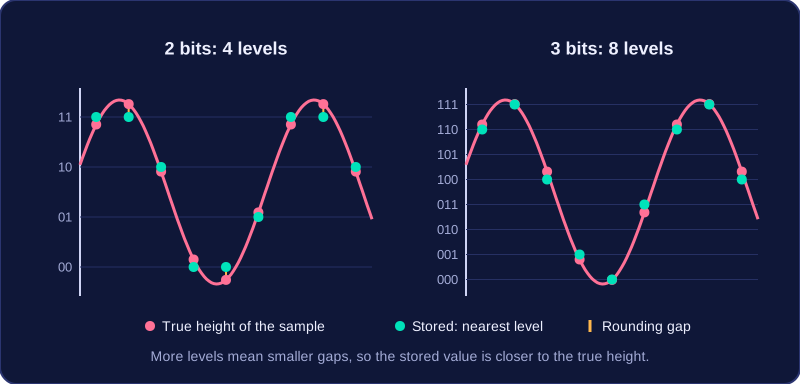
Because each sample is held as a binary number, a bit depth of n bits allows 2 to the power n different binary codes, and every code stands for one amplitude value. With 3 bits there are 2 to the power 3 = 8 levels; with 6 bits there are 2 to the power 6 = 64 levels. Each extra bit doubles the number of levels, because one more binary digit doubles the number of patterns you can make.
Imagine recording the rustle of a leaf. If the true amplitude falls between two available levels, the computer rounds it to the nearest one. At 3 bits the levels are far apart, so quiet details get rounded away. At 6 bits there are eight times as many levels, so each stored value can sit much closer to the real amplitude.
| Bit depth | Levels available | Accuracy of each sample | File size for the same duration and sample rate |
|---|---|---|---|
| 3 bits | 8 | Rougher rounding | Smaller |
| 6 bits | 64 | Finer rounding | Larger |
A higher bit depth gives more possible levels, so each sample is more accurate and playback quality is better. However, every sample needs more bits, so the file is larger. A lower bit depth gives fewer possible levels, so values are rounded more and the playback sounds rougher — but the file takes up less space.
Bit depth does not change how many samples are taken each second; that is the job of the sample rate. Bit depth changes only the number of levels available for storing each sample.
Practise this
OCR GCSE Computer Science · Sound