Hexadecimal
Hexadecimal
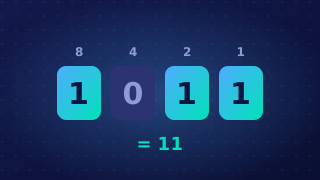
What happens if you need to display a large binary number such as:
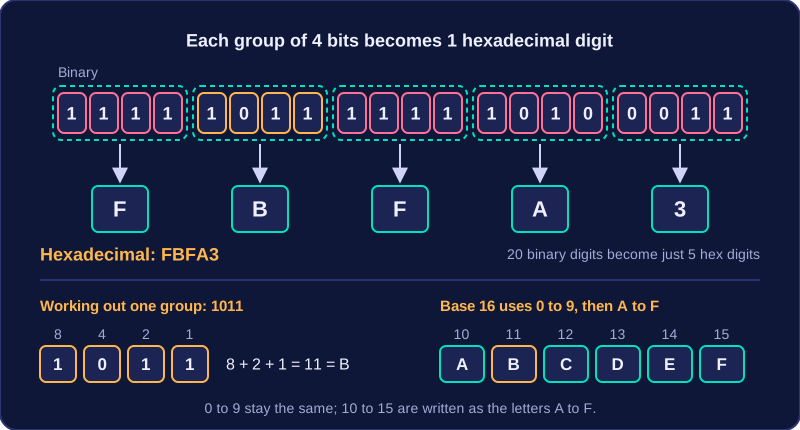
1111 1011 1111 1010 0011
Larger binary numbers are hard to remember and hard to write out without making a mistake. Hexadecimal is a number system (base-16) and makes use of 0-9 and A-F. It allows us to work with binary numbers in a more manageable way. Each 4 bits of a binary number can be represented with 1 hexadecimal digit. For example:
1011 = B
Hexadecimal numbers are used commonly when representing colours on web pages.
Practise this
KS3 Computing · Hexadecimal