Revision notes
Human Resource Decisions

Contents
- Motivation
- Benefits of a motivated workforce
- Remuneration: salary and wage
- Bonus and commission
- Fringe benefits
- Job rotation
- Job enrichment
- Autonomy
- Training and development
- Formal training
- Informal training
- Self-learning
- Ongoing training
- Target setting
- Performance reviews
- Retraining
- Benefits and costs of training and development
- Job roles in small and large businesses
- Directors and senior managers
- Supervisors, operational and support staff
- Recruitment and the recruitment process
- Job description and person specification
- Application form, CV and letter of application
- Internal and external recruitment
- Benefits of effective recruitment
- Organisational structures, charts and hierarchy terms
- Hierarchical and flat structures
- Centralised and decentralised structures
- Communication in business
- Part-time, full-time and flexible hours
- Permanent, temporary and freelance contracts
Motivation is the internal and external factors that stimulate a person's desire to do something or achieve a goal. Internal factors include pride in doing a good job; external factors include how a manager treats employees. Businesses want employees to put in effort because they want to, not just because they are paid to turn up.
Financial and non-financial methods
Financial methods reward employees with money or money-related benefits, such as pay, bonuses or fringe benefits. Promotion and fringe benefits are financial because they have a monetary value or lead to higher pay. Non-financial methods motivate through the nature of the work itself, such as giving employees more variety, challenge or control over how they complete tasks.
| Financial methods | Non-financial methods | |
|---|---|---|
| What they reward | Money or money-related benefits | The nature of the work itself |
| Cost to the business | Often higher, because money or benefits are provided | Often lower, as changes may be to how work is organised |
| When essential | When pay is low or feels unfair | When employees need interest, challenge or control |
Choosing the right mix
Non-financial methods often cost less than financial rewards and can last longer, because they change the everyday experience of work. But financial methods may be essential where pay is low or seen as unfair: if staff believe they are underpaid compared with similar local jobs, extra responsibility may feel like more work for the same money.
A small indoor climbing centre could pay its weekend instructors a higher hourly rate and ask one instructor to design the routes on a new wall. The extra pay deals with fairness; designing the routes adds interest and responsibility. Using both can work better than relying on either alone.
The most effective method depends on the type of job, the employees' needs and the business's budget. A call-centre role handling the same enquiries all day may need financial incentives alongside varied tasks, while a role designing new products may benefit more from freedom over how work is done. A combination of financial and non-financial methods is often used.
Motivation affects how employees feel about their work, and a motivated workforce creates a number of clear benefits for a business. These gains include keeping staff, attracting applicants, raising productivity and increasing profit.
Keeping staff and saving costs
Motivated employees are more likely to stay with the business, so staff turnover — the proportion of employees who leave and are replaced each year — falls. Every leaver can mean money spent on advertising the job, interviewing candidates and training a replacement. Avoiding those costs protects the business's finances. For example, a furniture workshop with 20 employees might usually lose four workers a year. If better motivation reduces this to one leaver, the owner avoids three recruitment rounds and three training programmes.
Attracting able applicants
A business with a reputation for happy, well-motivated staff attracts more people when a vacancy is advertised. A larger pool of applicants gives the business a wider choice of candidates and a better chance of appointing able employees. Those employees may then work more effectively and need less supervision.
Working harder and raising output
Motivated employees generally work harder and more effectively, which raises productivity — output per worker. If the furniture workshop's staff build 120 benches a week instead of 100, without extra wages, its costs are spread over more output and unit costs fall. The business can increase output without taking on extra staff.
Together, lower staff turnover and higher productivity increase profits and help the business to compete more effectively.
Remuneration is the financial payment you receive for the work you do. It is a financial method of motivation, and two common forms are salary and wage.
Salary
A salary is a fixed annual amount, usually paid in equal monthly amounts. For example, a salary of £27,000 a year is £2,250 a month, whatever the number of working days.
It gives the employee a predictable income, making budgeting easier, and the business finds pay costs easy to plan and budget. However, the employee gets no extra pay for overtime or extra effort, and the business pays the same even when output is low.
Wage
A wage is normally paid weekly and varies with hours worked or output. For example, £11 an hour for 30 hours is £330; 35 hours is £385.
The employee is paid for extra hours worked, so overtime is rewarded. The business pays only for time worked, which suits flexible or seasonal demand: an ice cream seller can pay for more hours in a hot week. But the employee's income can be uncertain, and overtime rates can raise business costs sharply when busy.
Comparing salary and wage
| Feature | Salary | Wage |
|---|---|---|
| Employee advantage | Predictable income | Paid for extra hours |
| Business advantage | Easy to budget pay | Pays only for time worked |
| Employee disadvantage | No extra pay for overtime | Uncertain income |
| Business disadvantage | Pays same when output is low | Overtime raises costs |
A bonus and commission are financial methods of motivating employees by linking part of their pay to performance.
Bonus
A bonus is extra money paid to a worker or a team on top of their usual wage, normally as a reward for hitting a target such as a sales figure or an output level. It motivates because the reward is directly linked to results: hit the target and you gain extra money. For example, a warehouse team that packs 5,000 orders in a month with fewer than ten errors might each receive a £50 bonus. The risk is that a badly designed target can push employees to cut corners or act unethically, such as rushing orders and skipping quality checks. Targets that are too high can also demotivate staff who feel the bonus is impossible to earn.
Commission
Commission is a payment to an employee of a percentage of the value of the products or services they sell. It is common in sales jobs, which often have a low basic wage. For example, a phone shop assistant on £1,000 basic pay per month plus 5% commission who sells £8,000 of phones earns £400 commission, making £1,400 in total. Commission encourages employees to sell more because their pay rises with sales. However, it gives an uncertain income, so a quiet month means lower pay. It can also lead to overly pushy selling or sales that are not in the customer's interest, such as persuading someone to buy a contract they do not need.
Fringe benefits are rewards an employer gives in kind rather than as money. Examples include a mobile phone the employee can use privately, private medical insurance, meals that the employer helps to pay for, and a gym membership paid for by the employer. They count as a financial method of motivation, even though employees are not handed money, because each benefit has a cash value and increases the total value of the pay package.
Why businesses offer them
| Benefit for the business | Why it matters |
|---|---|
| Attracting staff | A job advert offering private medical insurance and subsidised meals stands out against one offering only a wage, so more people apply. |
| Retaining staff | Employees who value a benefit are less likely to leave for a slightly higher wage elsewhere, which saves the cost of recruiting a replacement. |
| A competitive pay package | The whole package looks more attractive without the business having to find a large rise in basic pay. |
A small plumbing firm cannot match the wages of a large rival, so it gives each engineer a mobile phone for private use and pays for a gym membership. That package persuades experienced plumbers to join and to stay.
Drawbacks
Fringe benefits are costly to provide. Phones must be bought, insured and replaced, and gym memberships must be renewed each year. They also take time to administer, because someone must arrange each scheme, keep records and sort out problems. Employees may take benefits for granted once they have had them for a while. They may also undervalue one they never use, such as a gym membership for someone who never goes to the gym, so the motivational effect can fade.
Job rotation is a non-financial method of motivation where staff regularly swap roles on a planned basis, so no one stays on the same duties for long. For example, at a garden centre, an employee might spend one week on the checkout, the next in the plant area and the following week in the stockroom.
How it motivates
Rotation adds variety to the working day, which reduces the boredom of repeating the same task. It also helps workers build new skills, so they feel more capable and useful. A checkout assistant who learns how to care for plants and handle deliveries has more interesting work and a wider set of abilities.
Benefit to the business
Rotation creates a more flexible workforce. If one employee is absent, someone who has already rotated into that role can cover, so production or customer service can continue. This reduces disruption and means the business depends less on one person always being available.
Drawbacks
Job rotation can be costly because each employee must be trained for several roles instead of one. Productivity may also fall while workers learn a new task and are not yet fast or confident. For instance, a new stockroom worker may take longer to find items, slowing down shelf replenishment at first. Job rotation is not the same as job enrichment: it varies tasks at a similar level rather than adding extra challenge and responsibility.
Job enrichment is a non-financial method of motivation. It means giving an employee greater challenge and responsibility in the work they already do, so that the job itself becomes more satisfying. The job does not simply change to a different set of tasks: the tasks become more demanding and the employee is trusted with decisions that a manager or supervisor would otherwise make. Although the motivation comes from the work itself, enrichment may be accompanied by higher pay to reflect the extra responsibility.
It motivates because the work becomes more interesting and gives the employee a sense of achievement. A receptionist at a small hotel who is put in charge of planning the staff rota and dealing with complaints from guests has a job with more variety and more to feel proud of than someone who only answers the phone and hands over keys.
Drawbacks for the business
- Training is needed, so the employee can cope with the extra duties and decisions, which costs money and time.
- Staff are away from producing output while they are trained or take on planning and checking work, so output can fall in the short term.
- Not every employee wants extra responsibility. Some are happy with familiar work and may feel stressed or resentful if more is pushed onto them, so enrichment can demotivate as well as motivate.
Enrichment compared with job rotation
| Method | What changes for the employee |
|---|---|
| Job enrichment | The level of challenge and responsibility rises; the work becomes deeper, not just different. |
| Job rotation | The employee moves between tasks of a similar level, so the work varies but does not become more demanding. |
So a supermarket worker whose job is enriched might become responsible for ordering stock and training new starters, while a worker whose job is rotated simply moves from the till to the shelves and back again.
Autonomy is the freedom an employee has to decide how to do their work. A manager may set the goal, deadline and budget, but the employee chooses the method, the order of tasks or the approach. For example, a mechanic at a bike repair workshop might be told to fix a customer's gears by Friday, then decide which tools to use, which parts to replace and how to test the repair.
Autonomy is a non-financial method of motivation because the reward comes from the work itself rather than extra money. It can motivate employees by making them feel trusted and valued: being allowed to make real choices shows the business has confidence in them. That can raise job satisfaction and make staff more willing to stay.
Benefits for the business
Employees who know their job well can often make decisions faster than a manager who has to approve every small choice. Autonomy also makes better use of their knowledge, because the person closest to the work may spot the best solution. In the bike workshop, an experienced mechanic may choose a quicker, cheaper repair than a fixed procedure would allow.
Risks and limits
Autonomy can go wrong if employees lack the skills or information to decide well. Decisions may be poor or inconsistent between staff, which can harm quality and customer service. A new mechanic without enough training might fit the wrong part. The business therefore needs training and clear limits, such as a spending cap or safety rules. Autonomy does not mean there is no manager and no rules; it means employees have choices inside agreed boundaries.
Training means giving employees the knowledge and skills they need to carry out their job. Development is related but not the same: it improves an employee's skills and future potential beyond the requirements of their current job.
A leisure centre trains a new lifeguard to follow the pool's rescue procedure, because the job cannot be done safely without it. The same lifeguard could be developed by learning to plan rotas and handle complaints, ready to become duty manager one day. Training closes a gap the job has now; development builds capability for a later role.
Training and development compared
| Training | Development | |
|---|---|---|
| Purpose | Fixes a current skills gap | Builds potential for the future |
| Focus | The job they do now | Skills beyond the current job |
| Example | Telling a new starter how to use the till | Coaching that person to order stock and run shifts |
Ways businesses train and develop employees
Businesses use a mix of formal training, informal training, self-learning, ongoing training, target setting and performance reviews. They differ in how planned they are, who leads them, what they cost and how closely they stay tied to the current job.
A course run by an outside expert is planned and consistent, so it costs more, but it can be worth it where mistakes are dangerous. A colleague showing a new starter how to lock up at closing time is unplanned, free and fixed to today's task. Self-learning lets an employee study on their own, while ongoing training keeps everyone's skills current as technology and rules change. Target setting gives an employee a goal; a performance review then checks progress against it, so together they show where training or development is needed next.
Choosing a mixture
No single method suits every situation, so a business picks a blend that fits the role, the employee and its budget. A small bakery might train a Saturday assistant informally on their first shift, pay for its manager to attend a course on new allergen rules, and set the assistant a target for serving customers, which shows what to teach them next. That blend keeps costs down while making sure the skills the business relies on are there.
Formal training is organised, planned learning with clear content and intended outcomes. It is usually delivered to a group of employees, rather than one person learning casually from a colleague.
The business can run formal training itself or pay a specialist external provider to deliver it to a group of employees. It is paid for and focuses on a subject that is important to the organisation, such as health and safety, customer service or using new software. Formal training may also lead to a recognised qualification. For example, a leisure centre might pay an external trainer to put six lifeguards through a first-aid certificate. Every lifeguard learns the same procedure and finishes with a certificate that shows they can respond safely.
Advantages
| Advantage | Why it helps the business |
|---|---|
| Structured and consistent approach | Everyone receives the same content in the same order, so standards are easier to check and compare across the team. |
| Expert delivery | A specialist provider or trained in-house expert knows the subject well, so employees are less likely to pick up poor habits. |
| Recognised qualifications | A certificate or award shows customers, regulators or employers that the employee has met a known standard. |
| Essential or legal requirements | Training can cover health and safety or food hygiene, helping the business avoid accidents, fines and legal trouble. |
Disadvantages
| Disadvantage | Why it can be a problem |
|---|---|
| Cost | Fees for trainers, materials and certificates add up, especially for a large group. |
| Time away from work | Employees are not doing their normal jobs while they learn, so work may pile up or need cover. |
| Lost output | The business may produce fewer goods or serve fewer customers during training, reducing short-term sales. |
| Too general or not suited to every learner | A group course may move too fast or too slowly for some staff, and may not match the exact tasks they do. |
Formal training is therefore most useful when consistency, expert knowledge or legal compliance really matter. It is not automatically better than informal training, because the business must be confident the benefits are worth the fees and the disruption.
Informal training is casual and often unplanned learning that happens naturally at work, with no set goals or defined outcomes. Nobody designs a course or books a trainer: staff pick things up as they go.
How it happens
Informal training usually takes one of these forms:
- Watching an experienced colleague and copying what they do
- Receiving advice or tips during a shift
- Asking questions when you are unsure
- Learning by doing the job itself and making small adjustments as you go
For example, a new assistant in a bike repair shop might watch a senior mechanic adjust the gears on a customer's bike, ask why the cable tension was changed, then try the same job on the next bike with the mechanic nearby. No session was scheduled — the learning came from the work.
Advantages
- Low cost — no fees for trainers or courses, and no staff sent off site.
- Fast — a new starter can begin useful work on day one rather than waiting for a booked course.
- Fits around work — learning happens during quiet moments, so output barely drops.
- Builds teamwork — staff helping each other builds trust and communication.
- Closely related to the actual job — people practise exactly the tasks they will do, with the real equipment.
Risks
- Inconsistent — two colleagues may teach the task in two different ways, so quality varies between staff.
- Poor habits spread — a shortcut that is unsafe or wastes stock can be copied by the next person.
- No record — the business cannot show what an employee has learned or when.
- Gaps remain — nobody checks the full picture, so essential knowledge may never be covered.
- Depends on the colleague — if the person teaching is only average, the learner may never reach a good standard.
Informal training is still real training and can be very effective, but it works best alongside structured methods such as formal training when accuracy, safety or legal standards matter.
Self-learning is when an employee learns independently, without a teacher or trainer leading them. They might work things out by trial and error on the job, or follow their own programme of study such as an online course, a book or a set of video tutorials.
Because nobody has to organise a session, self-learning can happen at a time and place that suits the individual. If the employee has internet access, they could complete a course at home in the evening, or look up how to fix a problem on their phone between shifts. For example, a hotel receptionist who wants to produce clearer rotas could work through a spreadsheet course over two weekends rather than missing work for a day of classroom training.
Benefits
- Flexibility – learning fits around shifts, family life and busy periods, so the business loses less working time.
- Self-pacing – an employee who grasps a topic quickly can move on, while someone who struggles can repeat material until it makes sense.
- Potentially lower cost – free or cheap online resources can replace paying for a trainer, a venue and cover staff.
- Responsibility – employees who take charge of their own development often feel more valued and motivated, and they become more adaptable as the business changes.
Drawbacks
- Lack of guidance – nobody checks that the employee is studying the right thing or is on track.
- Incorrect methods – material can be out of date or wrong, and trial and error can build bad habits, so a faulty technique may go unnoticed for a long time.
- Self-discipline needed – without deadlines or a trainer, it is easy to put learning off, especially after a long shift.
- Limited support – when the employee gets stuck, there may be no one to ask, so progress stalls.
Self-learning therefore suits motivated staff and fairly straightforward skills, such as learning a new piece of software. It is far less reliable for complex, safety-critical or legally required training, where expert instruction is essential.
Ongoing training means employees regularly update their knowledge and skills throughout their working life, rather than learning everything once at the start of a job. It is sometimes called continuous training, and it never really finishes while someone stays in a role.
Ongoing training can be given to anyone in the business, not only new starters or managers. A cleaner may need a refresher on safe chemical handling, a receptionist may need training on a new booking system, and a kitchen assistant may need an update on allergen rules. Because the world of work keeps changing, skills that were up to date a few years ago can quietly go out of date.
Keeping up with change
Ongoing training helps employees keep pace with four kinds of change:
- Technology — new tills, booking software or machines replace old ones, so staff must learn the new way of working.
- Law — rules on safety, food hygiene, data protection and safeguarding are updated, so staff must know what is now expected.
- Working practices — a business may change how shifts are planned or how orders are packed, and everyone must follow the same new method.
- Customer expectations — customers may now expect quick online replies or card-free payments, so employees need new skills to serve them well.
For example, a garden centre that installs self-service checkouts might run short sessions for everyone, including the person who waters the plants, so that any member of staff can help a confused customer.
Continuing professional development
Some professional roles require a set amount of continuing professional development (CPD) each year to keep their skills current — a minimum number of training hours or activities that must be completed to stay qualified to practise. This protects the public, because clients can trust that a professional's knowledge is up to date.
Because it never finishes, ongoing training has to be planned into the working year; regular short sessions in quieter periods fit around the job more easily than one long course.
Target setting means identifying particular goals an employee has to achieve within a timeframe. A useful target is clear enough to measure, so everyone can tell whether it has been met. For example, a garden centre might ask each checkout worker to serve 20 customers per hour by 30 June, or aim to raise its customer satisfaction score to 90% by the end of the year.
Target setting can improve a business's productivity (how much each employee produces in a given time) and efficiency (how well a business uses its resources to get things done). Employees know what they are aiming for, so they waste less time guessing what matters. Managers can monitor progress and spot who needs help. Targets also link each person's work to the business's aims: if the business wants faster service, individual targets can focus on serving customers more quickly.
Targets and training
Training and development help employees gain the skills and confidence needed to meet targets. If a target needs a new skill, the business may provide training first, such as showing a worker how to use a new stock-counting app before expecting them to count stock accurately. If the employee still struggles after training, the target may be unrealistic, or the person may need further development.
Targets must be fair, achievable and checked. A target that is impossible or never measured can demotivate staff rather than push them forward, so managers review progress and adjust the target if circumstances change.
A performance review is a planned, regular meeting between an employee and their line manager to look at how the employee has been working and what they have contributed to the business. It is normally held one-to-one. It is not a customer review and it is not a disciplinary meeting: the aim is to improve performance, not to punish someone.
Reviews let employees reflect on their work and agree new targets. The discussion should be two-way and based on evidence, such as job records or customer feedback. Reviews also identify training and development needs, so the business can provide the right support. For example, at a bike repair workshop, a mechanic's review uses job sheets and customer comments. They agree a target to cut repair times, and the manager arranges training on e-bike motors.
Benefits
| Benefit | Why it helps |
|---|---|
| Feedback | Employees hear what they do well and what to improve. |
| Motivation | Feeling listened to and valued can make employees work harder. |
| Alignment of goals | Employee targets are set so they pull in the same direction as the business's aims. |
| Training needs | Reviews reveal skills gaps so training is targeted. |
| Promotion | Evidence of progress helps spot people ready for more responsibility. |
| Productivity and retention | Clear expectations raise output, and staff who know where they stand are less likely to look for another job. |
Drawbacks
- Time and cost: managers must prepare and hold reviews, taking them away from other work.
- Stress: employees may worry about being judged, especially if they expect criticism.
- Bias: a manager may favour someone or judge them unfairly, so the review is not evidence-based.
- Demotivation: negative feedback that is badly handled can make an employee feel undervalued.
A rushed review can feel like a box-ticking exercise, while an unfair one can feel like a judgement. Handled well, a review connects target setting, training and development so employees know what is expected and how to improve.
Retraining means teaching existing employees new skills, often so they can use new technology. It is different from the training a new starter receives: the people being retrained already work for the business, but their current skills no longer match what the job now needs.
When retraining is needed
Retraining is needed when something about the job changes, not just when someone is new. Common triggers are:
- New technology: for example, a bike shop installing diagnostic software so its mechanics can service electric bikes.
- New procedures: such as a café changing how it takes and tracks orders.
- New job requirements: a sales assistant asked to take on stock ordering needs new skills.
- Changes in the law: a food business retraining staff on allergen labelling rules.
Without retraining, employees may make mistakes, work slowly or break the law. The business usually pays for the training and loses some output while staff are learning, but that is often less than the cost of getting things wrong.
Why retrain existing staff?
Retraining is often cheaper and faster than recruiting and training new staff. You avoid advertising, interviewing and a long induction, and existing employees already know the business, its customers and its routines.
It can also avoid making experienced people redundant (losing their jobs because their role is no longer needed), so the business keeps their knowledge and experience. They can put new skills to use straight away because they understand how the business works.
Retraining can motivate staff too: being taught something new shows the business values them and helps them feel confident with the change. But it does not motivate everyone automatically, because some people find change difficult, so retraining should be planned and supported. It also helps the business stay competitive as technology moves on: a hotel with staff trained on a new booking system can serve guests faster than one still using paper diaries.
Training and development is an investment: the business spends money and time now in the hope of better performance later. Whether it is worth it depends on how the gains compare with the costs.
Benefits of training
Being trained makes employees feel valued, because the business has chosen to spend money on them. That can raise motivation, and motivated employees tend to work harder, produce more and take more care over quality. Training also empowers employees, giving them the knowledge to make decisions for themselves, which makes them feel trusted and builds loyalty.
Loyalty improves retention, so fewer staff leave and the business saves the cost of advertising the vacancy, interviewing and training a replacement who does not yet know the job. Sharper skills also cut errors, so less stock is spoilt and fewer jobs have to be put right, which lowers costs and protects profit. And employees who understand the product give better customer service, so customers are more satisfied and more likely to return.
Costs of training
Training is not free. The business pays for the course, trainer or materials; employees spend time learning instead of working; and there is lost output while they are away, which may mean paying others to cover or turning work away. Skills that are never used are wasted money, and a course that feels pointless can annoy staff rather than motivate them.
Worked example: a chain of three pet shops sends six staff on a one-day nutrition course at £90 each, paying £540 and losing six days of shop-floor cover. In return, staff answer pet-food questions properly, fewer products are returned and customers come back for advice, so the gains can outweigh the fee.
Businesses still invest because of the benefits: motivation, retention, productivity, quality, customer satisfaction and competitiveness. The decision is a judgement — weighing the cost of training against the expected gains in performance, staff loyalty and customer outcomes.
The number of job roles in a business, and how specialised each one is, depends on the size of the business. A small business has few people who each cover several roles, while a larger business divides work into many specialised roles with clearer responsibilities.
| Feature | Small business | Large business |
|---|---|---|
| Number of roles | Few; one person covers several | Many; each covers a narrower set of tasks |
| Specialisation | Low | High |
| Responsibilities | Shared and flexible | Clearly defined for each role |
| Communication | Quick, face to face | Slower, through more people |
Small businesses: one person, several roles
In a small business, one person may carry out several roles, such as owner, manager and salesperson. Picture a small escape room venue that employs four people. The owner takes bookings, pays the bills and deals with suppliers, but on a busy Saturday she also checks players in and resets rooms between games, while the other three staff swap between running games, mending props and answering the phone. With only four wages to pay, labour costs stay low, and problems are sorted out on the spot because everyone is working in the same few rooms. The downside is that each person needs a very wide mix of skills, and if two staff are off sick the venue struggles to open.
Larger businesses: specialised roles
In a larger business, there is enough work of each type to keep someone busy, so roles become specialised: each employee concentrates on a narrow range of tasks and has clear responsibilities. A large bicycle manufacturer, for example, has separate teams for design, buying components, marketing and finance, each led by its own manager. Repeating a narrow set of tasks helps employees become skilled and fast, and because each person knows exactly what they are accountable for, less is missed. The drawback is that departments can end up working separately and messages take longer to travel, so managers must work harder to keep everyone coordinated.
Directors sit on the board of directors, or senior management team, and lead a whole business function such as production or distribution. They rarely do the day-to-day work themselves; instead they are accountable for it, meaning they answer for how well their function performs and for the staff working in it. A production director at a chain of bakeries, for example, sets the quality standards every kitchen must meet and is answerable when one shop keeps selling underweight loaves.
The chief executive
The chief executive is the most senior director or manager in the business. They are responsible for its overall management and performance and make the major corporate decisions, such as whether to buy a rival chain or close a loss-making site. The other directors and the senior managers report to the chief executive.
Senior managers
Senior managers report to directors and run one particular team or department. Their role has three strands: planning work, deciding what must be done and by when; organising resources and staff, matching people, equipment and budgets to that plan; and monitoring performance, checking output, quality or costs against targets. In the bakery chain, the senior manager for production might plan the weekly baking schedule, arrange shifts across three kitchens and review daily waste figures, then report the results to the production director.
So accountability runs from senior managers to directors: senior managers answer for their team's performance, and directors answer for the functions they lead.
Day-to-day work in a business is often shared out between supervisors or team leaders, operational staff and support staff. Each role does a different job, and together they keep the business running.
Supervisors or team leaders
A supervisor or team leader works closely with a team in one department. They organise the work so targets are met, make routine decisions and solve routine problems. In a pottery painting studio, the studio supervisor might set each day's session plan, decide which assistant covers the kiln, and move staff around when a school group arrives late. These are everyday choices that keep the team on track, rather than big decisions about the future of the business.
Operational staff
Operational staff carry out the main day-to-day work of the business. They follow the instructions and targets set by their supervisor or team leader. In the same studio, operational staff greet painters, explain how to use the glazes, set out materials and fire the finished pieces. Their work is the reason customers visit, so if they fall behind, the business's targets slip.
Support staff
Support staff provide services that help the business function effectively and productively. They do not usually carry out the main activity; instead they make it easier for operational staff to do their jobs. At the pottery studio, a health and safety adviser checks that glazes and equipment are used safely and keeps the studio's risk assessments up to date, while a marketing assistant runs the studio's social media accounts and promotes party bookings to local families. Without them, the studio could not run smoothly or productively, even though neither of them teaches customers to paint.
Recruitment is the process of finding and hiring the best candidate for a vacancy. It is more than placing an advert: it runs from working out what the job needs, right through to helping the new employee settle in.
The stages of the recruitment process
- Analyse the requirements – the business decides what the job involves and what kind of person is needed, setting this out in a job description and person specification.
- Attract suitable candidates – the vacancy is advertised in a way that reaches the right people, so good applicants actually apply.
- Select the best applicant – applications are assessed and the strongest candidates are interviewed.
- Hire – the successful applicant is offered the job and given a contract of employment.
- Integrate – the new employee is introduced to the business, its people and its routines, so they settle in quickly and become useful sooner.
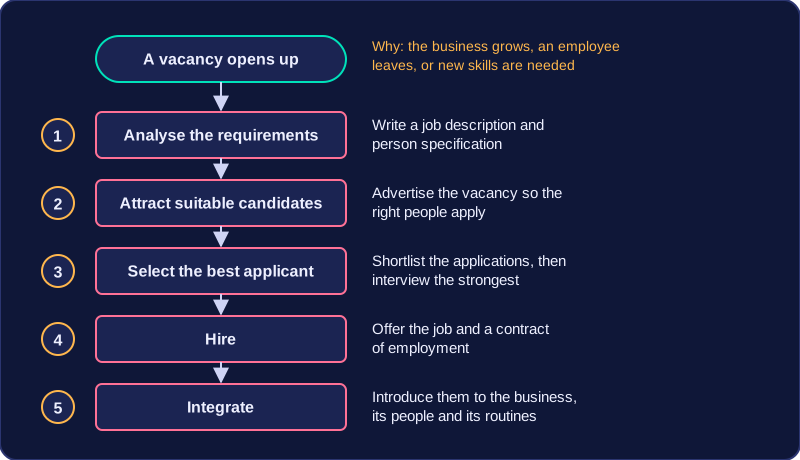
Why a vacancy opens up
- Growth – a bike repair shop that opens a second workshop needs extra mechanics, because the work now exists but there is nobody to do it.
- An employee leaves – through resignation or retirement, yet the tasks they did still need doing.
- New skills are needed – for example, a garden centre that starts selling online needs someone who can run its website and social media, a skill nobody already employed there has.
Selection: shortlisting and interviewing
Selection means assessing applicants to choose the best one. Shortlisting compares each application with the job requirements and keeps only the strongest matches, which saves the business the cost and time of interviewing everyone. Interviewing then tests candidates face to face – their skills, experience and how they would fit the team – so the final decision is based on evidence rather than paperwork alone.
A job description is produced by the business. It describes the job itself: the job title, the working conditions, the main responsibilities and the line of communication. Working conditions include details such as location, hours and whether weekend work is required. The line of communication shows who the employee reports to, so everyone knows who is in charge. This gives applicants a clear picture of what the role involves, and the business can use it to write the advert and plan interview questions.
A person specification is also produced by the business. It describes the person needed to do the job well. It lists the qualifications or education required, the skills and experience needed, and the personal qualities that would suit the role, such as being reliable, patient or able to solve problems. The business can use it as a checklist when shortlisting and interviewing.
The key difference
The job description focuses on the job and its duties. The person specification focuses on the candidate and the qualities they need. They are not the same document: one says what must be done; the other says what sort of person should do it.
| Document | Focus | Typical contents |
|---|---|---|
| Job description | The job | Job title, working conditions, responsibilities, line of communication |
| Person specification | The candidate | Qualifications, skills, experience, personal qualities |
For example, a small bakery advertising a bakery supervisor could use a job description to show that the role is based at its main shop, starts at 6am, involves planning daily baking and reporting to the owner. Its person specification could ask for a food hygiene certificate, two years' baking experience, good time management and a friendly manner. Both documents help the bakery attract suitable applicants and reject unsuitable ones quickly.
When a business advertises a vacancy, it uses several documents to help it choose the best person. Some are produced by the business, while others are produced by the applicant.
Documents produced by the business
An application form is produced by the business and completed by the applicant, who returns it to the business. It asks every candidate for the same details, such as contact information, qualifications and previous experience. This standardises applications, so the business can compare candidates fairly and quickly instead of comparing CVs laid out in many different ways. For example, a garden centre recruiting a trainee supervisor for its busy spring season could use its own form so that every candidate's details appear in the same order, making shortlisting quicker.
The business also produces the job description and person specification before recruiting. After a successful appointment, it may send a contract of employment, which sets out the terms of the job.
Documents produced by the applicant
A curriculum vitae (CV) is written by the applicant. It summarises their skills, experience and achievements, often in a short, easy-to-read format, so an employer can quickly see what the candidate has done before. A letter of application may be sent with a CV. It is also written by the applicant and presents why they are suitable for that particular vacancy, linking their skills and experience to the job.
Applicants may send a CV, a letter of application or a completed application form to the business, depending on what the business asks for.
Who produces each document
| Document | Produced by |
|---|---|
| Application form | Business; completed by the applicant |
| Job description | Business |
| Person specification | Business |
| CV | Applicant |
| Letter of application | Applicant |
| Contract of employment | Business, after a successful appointment |
When a vacancy arises, a business can fill it with an existing employee or with someone from outside. Each approach has different costs and benefits.
Internal recruitment
Internal recruitment fills a vacancy with someone already employed by the business rather than attracting outside candidates. It could be a promotion to a more senior job or a move sideways into a different role. The vacancy may be advertised inside the business, for example on the staff intranet, so current employees can apply.
Internal recruitment is often cheaper and quicker, as it avoids advertising widely and already knows the employee's performance. The employee understands the business, its customers and routines, so they settle in fast, and it can motivate staff to stay because they see a chance to progress.
However, the pool of candidates is limited to existing staff, so the business may get fewer new ideas or skills. Promoting one person can create another vacancy in their old role, and employees who were not chosen may feel resentful, which affects motivation.
External recruitment
External recruitment attracts candidates from outside the business, for example through a job-search website, to reach a wider pool of applicants. This brings fresh skills, ideas and experience, and is especially useful for a specialist role when nobody inside has the needed expertise.
The drawbacks are higher cost and more time spent advertising and selecting. The business cannot be certain how an unknown candidate will perform until they start, and existing staff may feel less motivated if they are overlooked for promotion.
Choosing the right approach
The choice depends on the business need: the skills required, cost, speed, whether fresh ideas are needed, and the effect on staff motivation. For example, a chain of indoor climbing centres starts running school-group sessions. Its instructors know the safety routines, so moving one into the job of organising school bookings is quick and cheap. However, none has sold to schools before, so recruiting an outsider with that experience takes longer and costs more, but brings knowledge the centres lack.
Effective recruitment means the business is clear about what the job involves and what kind of person it needs, attracts a good choice of applicants and selects carefully, so the new starter really fits the role. Getting that match right brings benefits that feed straight into the business's costs, its staff and its products.
Higher productivity and lower unit costs
A well-matched employee already has the skills the job needs, so they start contributing sooner and need less supervision. Productivity — output per worker — rises. Fewer mistakes also mean less time and material wasted, so the workforce is more efficient. Unit costs — the cost of producing one unit — fall when fixed costs such as rent or equipment are spread over more units made. The business can then keep its prices and earn a bigger profit margin, or charge less than competitors to win customers from them.
Vacancies filled quickly and lower labour turnover
Careful selection means people are better suited to their roles, so they are more likely to stay and to be content in them. Labour turnover — the proportion of staff who leave over a period and have to be replaced — falls, which saves re-advertising, re-interviewing and retraining. Recruiting well also fills a vacancy quickly, so customers are not kept waiting and existing staff are not left covering extra work for weeks.
New ideas and growth
Employees recruited from outside the business bring experience from other employers, which can spark innovation: new ways of working, such as a quicker booking system or a smarter way to display stock, or a product idea nobody had tried. If those ideas appeal to customers, the business can launch new products and take a larger market share — a bigger slice of total sales in its market.
For example, a chain of five garden centres recruits an assistant manager who has already run online order picking, a skill written into the person specification. Within weeks the new starter sets up click-and-collect, which cuts queue times and frees staff from the tills to advise customers — lower unit costs and a busier shop.
Organisational structure is the way people and roles are arranged in a business. It shows who reports to whom and how work is divided, so everyone knows where they fit. For example, a garden centre might divide work into plant sales, the cafe and the checkout, with each team reporting to a manager.
An organisational chart is a diagram of that structure. It shows the levels of hierarchy, lines of responsibility and channels of communication. The chart is only a picture of the structure, not the structure itself, and it can become out of date when roles change. It also cannot show informal communication, such as two colleagues sorting out a problem in a quick chat.
Hierarchy terms
| Term | Meaning | Example |
|---|---|---|
| Hierarchy | The number of levels of management in an organisation. A taller hierarchy has more levels. | A director, a manager, a supervisor and an assistant form four levels of hierarchy. |
| Chain of command | The route through which instructions and information pass down the hierarchy. | An instruction may pass director to manager to supervisor to assistant. |
| Span of control | The number of employees who report directly to a manager. | A supervisor who directly manages six assistants has a span of control of six. |
A worked example
A garden centre has a director, a retail manager, three department supervisors and twelve assistants. The retail manager directly manages the three supervisors, so the retail manager's span of control is three. Each supervisor directly manages four assistants, so a supervisor's span of control is four. The business has four levels of hierarchy, so its hierarchy is taller than a business with only a director and assistants. An instruction from the director to an assistant travels along the chain of command: director, then retail manager, then supervisor, then assistant.
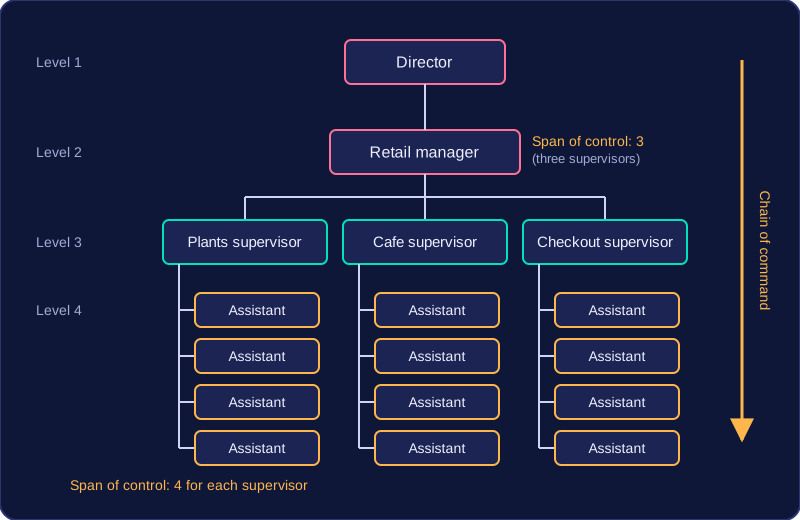
A hierarchical structure (also called a tall structure) has many levels of management. Each manager usually has a narrow span of control, meaning they directly oversee only a few employees. This suits large, complex organisations that need clear lines of authority and close control.
Hierarchical: strengths and weaknesses
Clear roles mean employees know who to report to and what is expected. Close supervision helps managers spot mistakes, and defined promotion steps give staff a visible career path.
However, messages pass through several levels, so communication can be slow and distorted. Decisions take longer because approvals move up the hierarchy, and paying several layers of managers raises costs. The business may also react slowly to customer or market changes.
For example, a 1,200-employee maker of specialist hospital beds may use five management layers, from team leaders to a production director. This keeps safety checks tight, but a customer request for a design change may take weeks to approve.
Flat structures
A flat structure has few levels of management and often a wide span of control: one manager oversees many employees. It suits small businesses or organisations that want quick decisions, teamwork and employee empowerment.
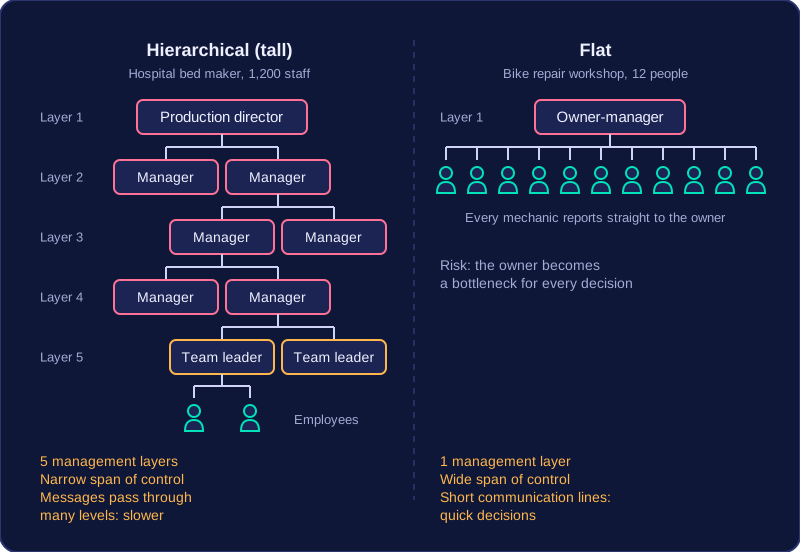
Short communication lines let information move quickly, so decisions are fast and management costs are lower. Giving staff more responsibility can increase motivation and teamwork. The drawbacks are that managers can become overloaded, supervision is less close and there are fewer promotion opportunities; without clear job descriptions, staff may also be unsure who does what.
For example, a 12-person bicycle repair workshop might have one owner-manager who every mechanic reports to directly, so mechanics can agree small extra repairs with customers on the spot. The owner must avoid becoming the bottleneck for every decision.
Centralised structure
A centralised structure is one where most decisions are made by senior managers or head office and then passed down to branches or lower levels. It is appropriate where consistency, control and specialist senior decision-making are important, especially for a business with multiple branches. For example, a chain of five indoor climbing centres could have head office set every site's prices, safety rules and opening hours. Customers get the same experience at each centre, senior staff can apply specialist knowledge, and buying equipment in bulk lowers average costs through economies of scale. Head office also keeps tighter control. However, decisions can be slower because branch staff wait for approval. Local managers may feel demotivated if they cannot respond to a local school wanting a weekday session, and the business can seem remote from local needs.
Decentralised structure
A decentralised structure is one where managers at local or branch level make decisions rather than only senior managers. It suits situations where local markets differ, quick local decisions are needed, or branch or franchise managers operate with independence. In the climbing chain, each centre manager could choose their own class timetable and local advertising. Decisions are faster, local knowledge is used well, and managers feel trusted, empowered and motivated, which can improve customer service. The drawback is inconsistency: one centre might offer a discount that another refuses, so the brand feels uneven. Central control is weaker, tasks such as buying equipment may be duplicated and cost more, and some decisions may lack specialist expertise.
Centralised is about who decides, not how many management layers exist; a flat structure and a decentralised structure are different ideas. Decentralisation is not automatically better, because motivation gains can be outweighed by inconsistency and lost control.
Effective communication takes place when a message passes from a sender to a receiver and both of them give it the same meaning. Sending information is not enough; the receiver must interpret the message as it was intended.
Choosing a method
Communication can be verbal (face to face or by phone), written (letters, notices or reports) or electronic (email or instant message). The method and channel should suit the audience and purpose. For example, a café owner might hold a short team meeting to explain a same-day change to the lunch menu, but email the full allergy information so staff can check it carefully.
Why it matters
Effective communication coordinates work, reduces mistakes, supports motivation and improves efficiency. When people know what to do and why, tasks are less likely to be duplicated and staff feel more involved.
Insufficient communication can leave roles unclear, cause mistakes, lower morale, create conflict and reduce productivity. Excessive communication is also a problem: too many messages can cause information overload, stress, wasted time and confusion, lowering efficiency.
Barriers
Barriers include jargon (specialist words the audience does not know), language differences, noise or a poor channel, information overload, lack of feedback, emotional or personal factors, and cultural differences. Each one can stop the receiver understanding the message as intended. A warehouse manager who uses stock-code abbreviations in a message to new staff may be understood by experienced workers but not by newcomers.
Part-time employees work fewer hours than full-time employees. Full-time employees work the standard full working week for the business. Flexible hours means the total number of hours is agreed, but the times when they are worked can vary.
Part-time working
Part-time working helps a business match staff to busy periods, such as a garden centre taking on two extra assistants for weekend mornings in spring. It also reduces total wage costs because fewer hours are paid. However, recruitment and training costs are spread over fewer hours, so the cost per hour worked is higher, and continuity can suffer if part-time staff are only in for a couple of days each week. Part-time work suits employees with caring responsibilities, study or other commitments, but usually means lower income and fewer chances of promotion. Part-time staff normally receive the same hourly rate as full-time staff; they simply work fewer hours.
Full-time working
Full-time staff give a business continuity and easier scheduling, as they are available throughout the working week. The drawbacks are higher fixed wage costs and less flexibility when demand changes, for example a café that is quiet in January still pays the same wages.
Flexible hours
Flexible hours can help a business match staffing to demand, for example a bakery whose staff all agree to 30 hours a week but start at 5am or 7am on different days. It can also improve motivation and retention, because employees can fit work around personal commitments. Scheduling and coordinating staff is harder, especially when team members need to work together at the same time. Employees gain a better balance with personal commitments, but they may need to be available at less convenient times, which can make arranging childcare harder.
Contracts set out the terms someone works under, including how long the job is expected to last. Businesses mix contract types to match their staffing to demand.
Permanent contracts
A permanent contract has no end date. It continues until the employee resigns or the employer ends it with the agreed notice period. Knowing their income is secure can make staff feel motivated and loyal, so they stay longer and the business spends less on recruiting and training replacements. The trade-off is a fixed wage bill that continues when trade is quiet, and staff who are harder to cut back quickly. The employee gains security but must give notice to leave.
Temporary contracts
A temporary contract lasts for a fixed period or until an agreed end date. A garden centre might take on extra staff for the weeks before Christmas, when demand for trees and decorations peaks. The business can add staff for busy periods, cut back afterwards and use the role as a trial before offering a permanent job. However, temporary staff may be less motivated and loyal, and each intake needs recruiting and training. Workers gain experience and flexibility but have little security or certainty over income.
Freelance contracts
A freelance contract is when a self-employed person, not an employee, carries out short-term work for clients. A wedding photographer who is booked for one event at a time works for themselves and serves several clients. A business can buy specialist skills only when needed, avoid a permanent salary and scale work up or down. The drawbacks are less control over availability, higher hourly rates and less influence over how the work is done. The freelancer gains independence and variety but has no guaranteed income, holiday pay, sick pay or job security.
| Contract | Security for the worker | Flexibility for the business | Cost |
|---|---|---|---|
| Permanent | High: steady income until notice is given | Low: fixed wages and notice periods | Fixed wage bill; lower recruitment costs if staff stay |
| Temporary | Low: ends on a set date | High: staffing matches demand | Recruiting and training each new intake |
| Freelance | None: work is not guaranteed | High: hired for specific jobs | Higher hourly rate, but no ongoing employment costs |