Forms of Notation
Information flow diagrams

An information flow diagram is a form of notation that shows how information is communicated from a source to a destination. It sets out two things: what information is sent, and who sends and receives it. Every act of communication in a scenario appears as a transfer from one participant to another, so the whole pattern of communication can be seen in one place.
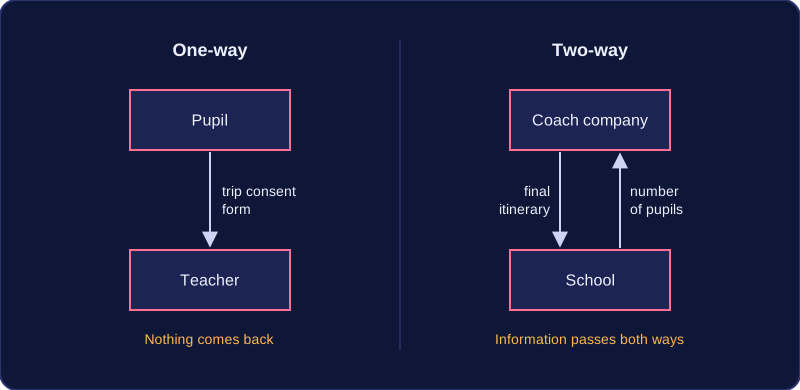
The diagram can show one-way communication, where information travels from a sender to a receiver and nothing comes back, or two-way communication, where information passes in both directions. The focus is on information rather than technology: it shows the information flowing through a system and what information the system uses at each point, so a reader can see which parts of the system rely on which pieces of information. For example, a coach company emails a school the final itinerary for a trip, and the school replies with the number of pupils travelling. That is one two-way exchange, and each arrow carries a label naming the actual information, such as 'final itinerary' or 'number of pupils', so there is no doubt about what is being passed on.
| Type of communication | What it shows | Example |
|---|---|---|
| One-way | Information travels from a sender to a receiver with nothing coming back. | A pupil sends a completed trip consent form to a teacher. |
| Two-way | Information passes in both directions. | A coach company emails a school the trip itinerary and the school replies with pupil numbers. |
Why organisations use them
Organisations use information flow diagrams to explain their systems, data and information to staff, managers, clients and new employees. A diagram should be designed so that it is easier to read than a text description of the same information. The reader should see the whole pattern of transfers at a glance instead of working through paragraphs to find out who tells whom what. This makes it quick to check that every necessary communication is shown, and it gives everyone the same clear picture of how information moves through the organisation.
Practise this
Pearson BTEC Digital Information Technology · Information flow diagrams