Forms of Notation
Drawing information flow diagrams

An information flow diagram is drawn from a written scenario, so the scenario is the only source: everything it describes should appear, and nothing it does not describe should creep in.
The method
- Read the scenario and list every person, department or organisation that sends or receives information. Each one is an entity.
- Draw each entity as a box, ellipse or circle, with its name written inside the shape.
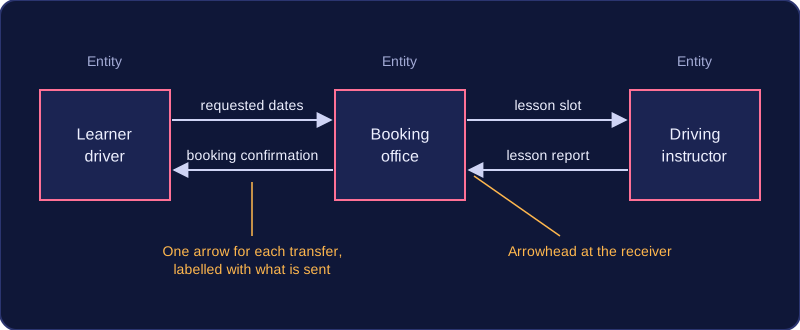
- For each separate transfer, draw one flow line from the sender to the receiver, with the arrowhead at the receiver's end.
- Label every arrow with the specific information carried.
- Re-read the scenario and check that every step is represented by an entity or an arrow, and add anything you have missed.
For example, a scenario about booking a driving lesson might name a learner driver, a booking office and a driving instructor. Listed as transfers it reads: the learner sends requested dates to the office; the office sends a booking confirmation to the learner; the office sends the lesson slot to the instructor; the instructor sends a lesson report to the office. Four transfers means four labelled arrows, not one arrow labelled booking, which would lose three of them.
What a correct diagram needs
A correct diagram has three features. The notation must be right: entity shapes joined by labelled arrows, never flowchart symbols. The connections and directions must be right: each arrow starts at the sender, finishes at the receiver and points the right way. And the coverage must be complete: every information flow the scenario describes appears. A diagram that misses a transfer, reverses an arrow or leaves a label off is incomplete, even if the rest of it is neatly drawn.
Drawing the diagram is an early step in designing a system. Settling who sends what to whom first means the later decisions, such as what data has to be kept and which technologies will carry it, are based on the information that genuinely has to move rather than on guesses.
Practise this
Pearson BTEC Digital Information Technology · Information flow diagrams