Truth tables
Truth Table Exam Technique
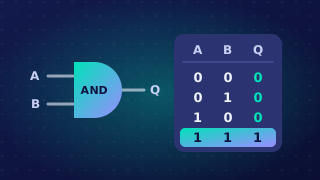
In an exam, a truth table is marked on two things: the values you write and the way you write them. The examiner compares each row of your table with the expected values, so anything that cannot be read clearly as true or false loses marks even when your reasoning was right.
One notation, start to finish
Choose 1 and 0 or True and False, then stay with that choice in every column. Mixing them, such as 1 in one column and False in the next, makes your table hard to follow and can cost marks. T and F, and On and Off, are also accepted, because each pair gives one clear value for true and one clear value for false. Ticks and crosses are not accepted, so use one of these pairs instead. Do not invent a symbol of your own: it is not a truth value, so there is nothing for the examiner to compare with the expected 1.
Marks for inputs, marks for outputs
The input columns are usually worth marks on their own, separate from the output column. A table with a flawless output column but a missing input combination therefore still drops marks, because every possible combination of the inputs has to appear exactly once. Near the end of the exam, read across the input columns row by row and check that no combination repeats another.
Carry-through marks
If a value in an input column is wrong, the rest of that row is not automatically lost. The examiner applies the logical operators to the values you actually wrote, and when your output fits those values you keep the output mark. This is called a carry-through mark. Suppose the expression is R OR NOT S and one row should read R = 0, S = 1, so the output is 0. You write S = 0 by mistake, then write the output as 1. Applying OR and NOT to the values you actually wrote gives 0 OR NOT 0, which is 1, so the output value is still marked correct, while the input value itself is marked wrong.
Practise this
Edexcel GCSE Computer Science · Truth tables