Libraries
Procedures and Functions
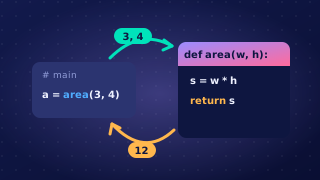
A subprogram is a named block of code that you call when you need it. Subprograms come in two kinds, and the difference between them is what the call hands back.
Procedures do a job
A procedure carries out a task but does not return a value. You call it for what it does, not for what it gives back. A procedure that adds an item to a list shows this clearly — scores.append(3) changes the list, and that is the end of it; nothing is handed back to store or calculate with.
Functions hand a value back
A function is a subprogram that returns a value to the point in the program where it was called. The call is swapped for that value, exactly as if you had typed the value yourself, so the rest of the line carries on with it. len("marble") returns 6, which is why len("marble") * 3 works out 18. round(7.6) returns 8, and str(25) returns the text "25"; returned values like these can be stored or used straight away.
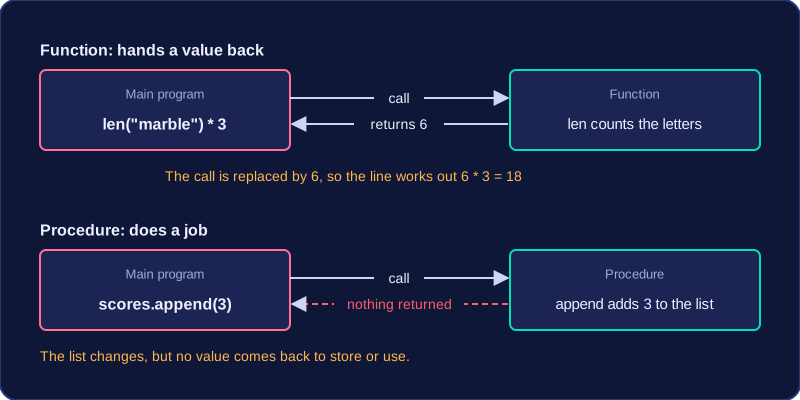
| Call | Procedure or function | What happens |
|---|---|---|
scores.append(3) | Procedure | 3 is added to the list; no value comes back |
len("marble") | Function | 6 comes back to the point of the call |
round(7.6) | Function | 8 comes back |
str(25) | Function | The text "25" comes back |
Using a returned value
A returned value is not shown on screen by itself. If nothing is done with it, it is lost and the program simply moves on. You can store it in a variable, print it, or use it straight away in a calculation.
sport = "tennis racket"
points = len(sport) * 2
points_text = str(points)
print(points_text)
Output:
26Here len(sport) returns 13, and that number is used in the calculation of points. str(points) returns 26 as text, which is stored in points_text. print(points_text) then displays that text as a procedure, returning nothing to the program. A line containing only len(sport) would count the letters and throw the count away.