Software Basics
Disk Defragmentation Software
Disk defragmentation software is a utility that reorganises how files are stored on a disk. It finds fragmented files, which are files split into pieces in different places, and rearranges their parts so each file is stored together.
Why fragmentation slows a disk
A disk is divided into small storage units. When you save a file, the computer fills the free units. If there is no single run of free units large enough, the file is broken into pieces and stored in gaps around the disk. Opening that file later means the read/write head of the disk must travel to several separate places to gather every piece. That extra movement takes time, so access is slower.
What defragmentation does
Defragmentation software scans the disk and moves the pieces of each fragmented file into neighbouring units. Each file can then be read in one continuous sequence, which improves access speed. For example, a video editing project file might have its start near the beginning of the disk, its middle near the end and its last section in a gap between other files. Defragmentation moves those three parts together, so the project can be read with less jumping around the disk.
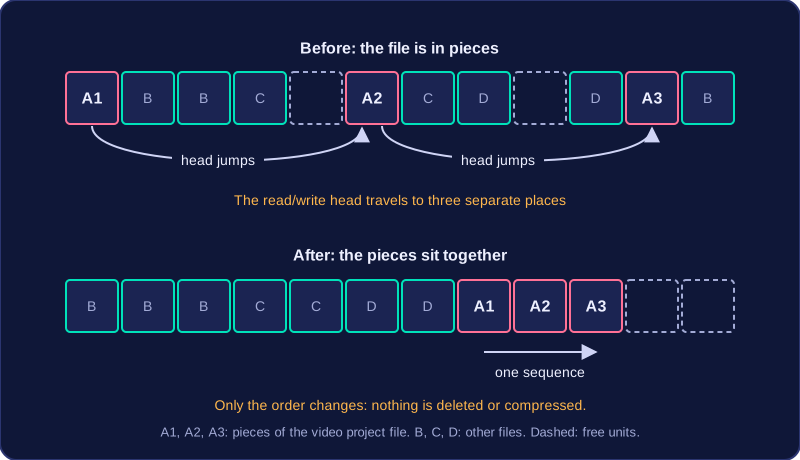
Defragmentation only rearranges files. It does not delete unused files, and it does not compress files to make them smaller. Any improvement in speed comes from storing the parts of each file together, not from removing data.
Practise this
Edexcel GCSE Computer Science · Software Basics
Edexcel GCSE Computer Science · Utility Software