The Internet
The Internet Backbone
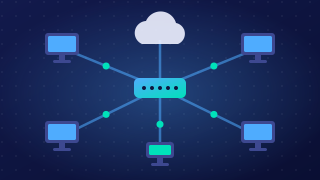
The internet backbone is the set of very high-speed, high-capacity links that join the world's major networks together. Homes, schools and most offices do not plug straight into it. Their traffic works its way up through a chain of networks until it reaches the backbone, is carried a long way very quickly, and then comes back down to the destination network.
Reaching the backbone through routers
A router is the device that connects one network to another and passes packets between them, so every step on the way up to the backbone goes through a router. Your local network is linked to an Internet Service Provider (ISP) by a router, the ISP's network is linked to larger networks by more routers, and one of those larger networks connects into the backbone itself.
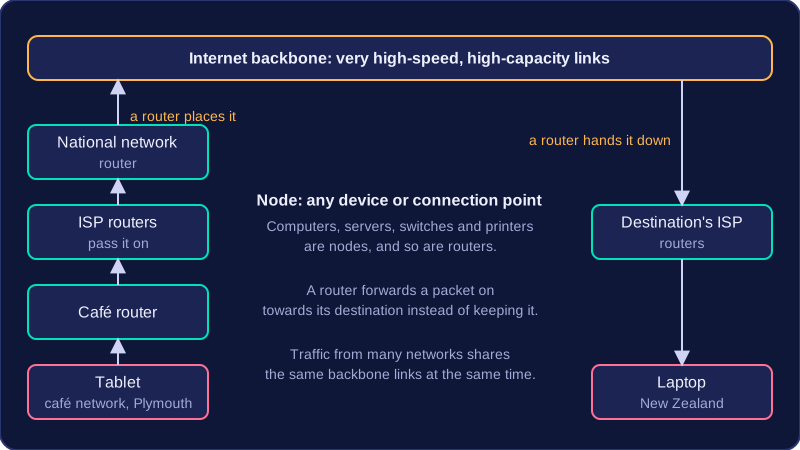
For example, a tablet on a café's network in Plymouth sends a packet to a friend's laptop in New Zealand. The café's router passes the packet to the ISP, routers inside the ISP pass it on to a national network, and a router there places it onto the backbone. The backbone's high-speed links carry it across the world until a router hands it back down through the destination's ISP to the laptop.
Nodes on the network
A node is any device or connection point on a network. Computers, servers, switches and printers are all nodes, and so is the point where two links meet. Routers are nodes too, but they do a special job: a router forwards a packet on towards its destination instead of keeping it, which is what makes the backbone a chain of links and routers rather than one long cable. On the backbone, the nodes are the large routers and the connection points where major networks join the high-speed links, so traffic from many separate networks shares the same backbone links at the same time.
Practise this
Edexcel GCSE Computer Science · The Internet