LANs & WANs
LANs and WANs
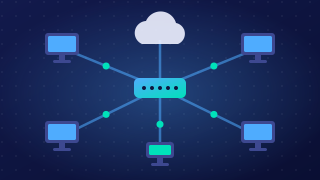
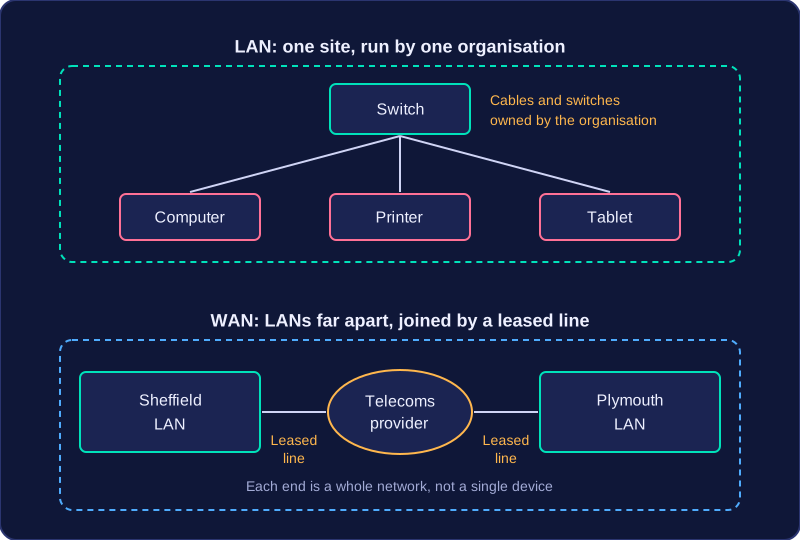
LAN stands for Local Area Network. It is a network that covers a small geographical area, usually a single site such as one building, and it connects individual devices — computers, printers, tablets — within one organisation.
Because everything sits on one site, it is practical for the organisation to own and control the infrastructure itself: the cabling, switches and wireless access points are its own equipment, and its own staff decide who gets access. A village hall where the booking office, main hall and kitchen all link together is running a LAN.
Wide Area Networks
WAN stands for Wide Area Network. It covers a large geographical area and joins two or more networks or LANs at distant locations, so it links whole networks together rather than plugging individual devices straight into each other.
A WAN usually relies on third-party communication links, such as leased lines rented from a telecommunications provider, because running your own cable between distant towns is rarely practical or affordable. A chain of climbing centres with sites in Sheffield and Plymouth could link each site's LAN into one WAN. The internet is a global WAN that connects many separate networks.
A WAN is not only the internet — an organisation can run a private WAN between its own sites. Equally, Wi-Fi covering a single site is not a WAN, because wireless links can sit inside a LAN.
LAN or WAN?
| Feature | LAN | WAN |
|---|---|---|
| Geographical area | Small, usually one site | Large, with locations far apart |
| Who owns the infrastructure | The organisation that runs it | Often a third party, such as a telecoms provider |
| What it connects | Individual devices | Separate networks or LANs |
| Example | The booking office, main hall and kitchen of the village hall | The climbing chain's sites joined together |
So a LAN suits a single site, while a WAN is needed once sites are far apart — and the difference is about area, ownership and what is being connected, not simply the number of devices.
Practise this
Edexcel GCSE Computer Science · LANs & WANs
Edexcel GCSE Computer Science · The Internet