Secondary Memory
Choosing a Storage Device
Choosing a secondary storage device means comparing devices on six characteristics — capacity, speed, portability, durability, reliability and cost — then picking the one whose strengths match the job. Very few devices are best at everything: one that holds a lot cheaply may be bulky or slow, so decide which characteristics matter most and accept weaknesses elsewhere.
What each characteristic means
| Characteristic | What it measures | Question it answers |
|---|---|---|
| Capacity | How much data it can store, in GB or TB | Will my files fit? |
| Speed | How quickly data can be read or written, in MB per second | Will files open and save quickly? |
| Portability | How easy it is to carry: size, weight, cable and power needs | Can it travel in a bag daily? |
| Durability | How well it survives knocks, drops, extreme temperatures and magnetic fields | Will it be knocked about or stored somewhere hot? |
| Reliability | How likely data is to be lost through failure or corruption | Can I trust it with the only copy? |
| Cost | The device's price and the cost per GB of storing data on it | Is it affordable for the amount I need? |
Durability and reliability are easy to muddle. Durability is about the device surviving physical harm; reliability is about whether your data stays intact. A device with no moving parts tends to be strong on both: there is no disk to scratch if it is dropped, and no motor to wear out.
A worked example
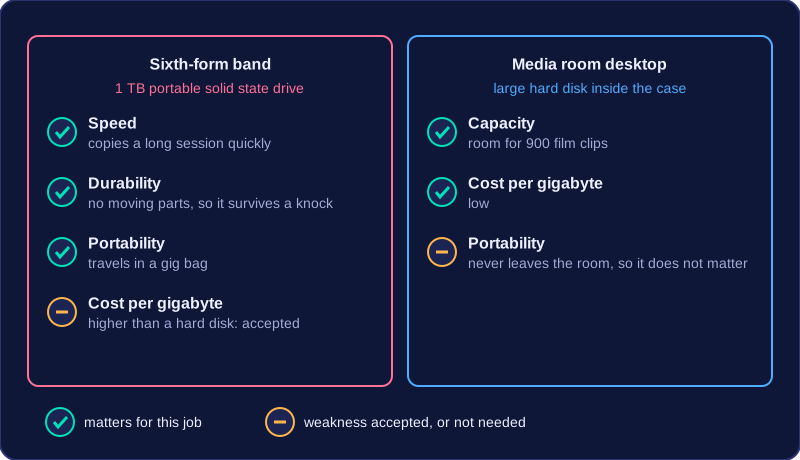
Two jobs in one school pull the weighting in opposite directions. A sixth-form band rehearses in the hall and mixes recordings at home, so session files travel in a gig bag. A 1 TB portable solid state drive fits: it copies a long session quickly, holds several unfinished tracks, and survives a knock because it has no moving parts. Each gigabyte costs more than on a spinning disk, but speed and toughness matter here. The media room needs the reverse. Its desktop stores 900 film clips opened all day, so a large hard disk inside the case is better: room for everything at a low cost per gigabyte, and it never leaves the room, so portability counts for nothing.
Practise this
Edexcel GCSE Computer Science · Secondary Memory