Embedded Systems
Embedded Systems in Devices
An embedded system is a small computer system built into a larger product to monitor and control how that product works. It is part of the device itself, not something separate you sit down and use on its own.
Embedded systems are used in a huge range of products and machines, from a security floodlight beside a house to the chiller in a vending machine. Each one is there to monitor and control the operation of the device it lives in.
Input from sensors, output to components
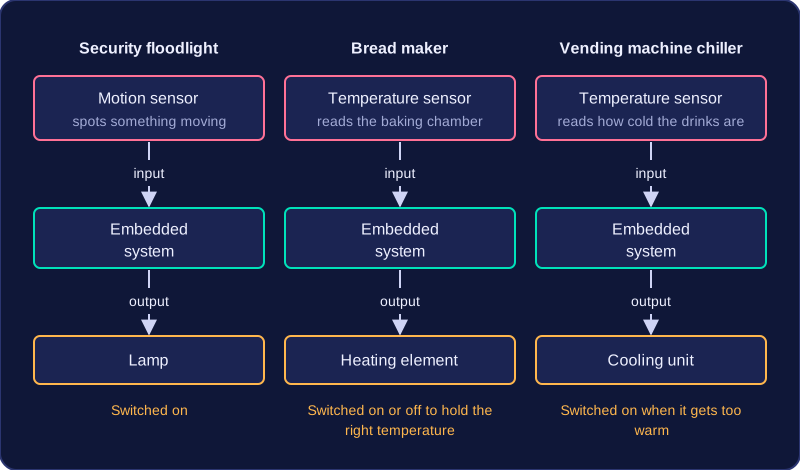
An embedded system takes input from sensors so it can tell what is happening, then produces output to control other components so that something happens as a result.
| Device | Input from a sensor | Output controlling a component |
|---|---|---|
| Security floodlight | Motion sensor spots something moving | Lamp is switched on |
| Bread maker | Temperature sensor reads the baking chamber | Heating element is switched on or off |
| Vending machine chiller | Temperature sensor reads how cold the drinks are | Cooling unit is switched on when it gets too warm |
The bread maker shows the idea well: the system compares the chamber temperature with the one the recipe needs and switches the heating element on or off to keep it right, so the device holds its own temperature without anyone turning a dial.
More than one system in a device
A larger device may contain several embedded systems, each controlling a different function. A 3D printer might have one system holding the nozzle at the right temperature, another driving the motors that move the print head, and a third watching a filament sensor that pauses the print when the reel runs out.
Why the device depends on them
Embedded systems are what let a device perform its specific functions; without them the device could not carry out those functions. Take the system out of a security floodlight and the lamp has no way of knowing when someone walks past, so it becomes an ordinary lamp. The system is the part inside doing the controlling, not the whole product.
Practise this
Edexcel GCSE Computer Science · Embedded Systems