Embedded Systems
Embedded System Hardware
An embedded system is a computer that is built into another device and exists to help that device carry out its job. Everything it needs — a processor, its memory (RAM and ROM) and the connections for input and output devices — is built into one unit sealed inside the product it is part of.
Inside that unit, each part has a clear job:
- Processing unit — follows the stored program and works out what to do with the data coming in.
- RAM — holds the values being worked on at that moment, such as the latest reading from a sensor. It is wiped when the power goes off.
- ROM — holds the program permanently, so the device can start its job the moment it is switched on, without anyone loading software.
- Input/output devices — inputs such as sensors or buttons feed information in; outputs such as motors, heaters or lamps carry out the result.
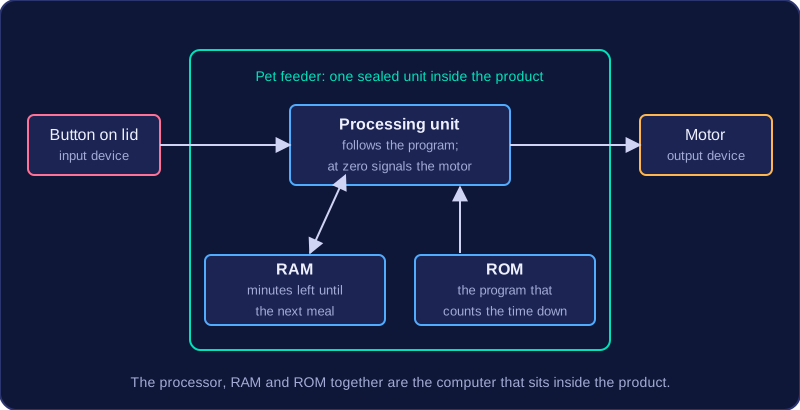
Worked example
Think of the timer inside an automatic pet feeder. A button on the lid is the input, and RAM holds how many minutes are left until the next meal. The ROM program counts the time down and, when it reaches zero, sends a signal to the motor that opens the food flap. The whole computer sits inside the feeder's plastic case, and you never see it.
Microcontrollers
Many embedded systems are built around a microcontroller. This is a single chip that already contains RAM, ROM and a simple processor, so the designer does not have to wire three separate chips together. A keypad safe might use one: the chip's ROM holds the program that compares each code typed on the keypad with the stored code, and if they match it sends a signal to the output that releases the lock.
A microcontroller is not the whole embedded system. It is the chip at the centre; the embedded system also includes the inputs and outputs it is connected to, all inside the same product.
Practise this
Edexcel GCSE Computer Science · Embedded Systems