Sound
Analog vs Digital
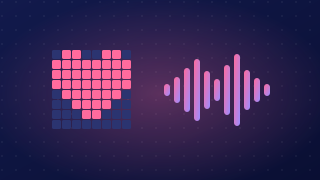
Analogue signals change smoothly and continuously. A microphone turning a voice into a changing voltage is analogue: at any instant the voltage can take any value in its range, and it never jumps from one value to the next. Digital data is different. It is stored as binary, using only 1s and 0s, so it can only take a fixed set of discrete values.
A computer cannot store a continuously changing wave directly, so it measures the wave at regular intervals. Each measurement records the wave's height at that instant, and is stored as a binary number.
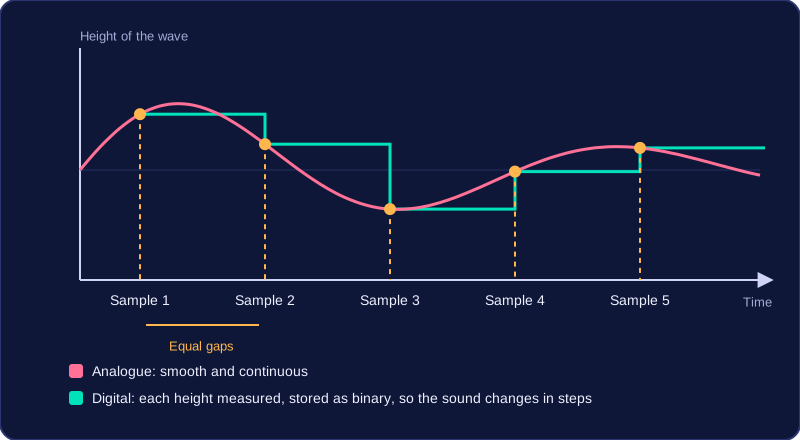
Why the intervals must be regular
Suppose a drummer hits a cymbal and the sound rises and falls over half a second. Measuring at five equally spaced moments gives five height values. Stored as binary, those five numbers let software rebuild an approximate version of the sound. If you measured only once, you would know how loud the cymbal was at that instant, but not how the sound changed before or after. The regular spacing also lets the computer match each binary value to a point in time when it rebuilds the wave. Spacing that varied would shift sounds to the wrong moments, so the timing would be wrong even if every value were stored correctly.
| Analogue sound | Digital sound | |
|---|---|---|
| Values | Continuous; any value in a range | Discrete; only binary values |
| Change | Smooth, with no jumps | Changes in steps from one stored number to the next |
| Computer storage | Cannot be stored directly | Stored as measurements converted to binary |
Practise this
Edexcel GCSE Computer Science · Sound