Malware
Worms

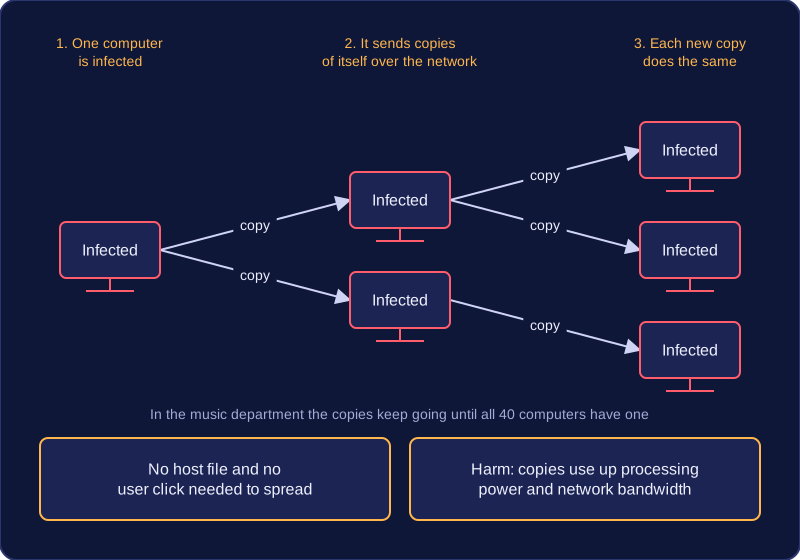
A worm is a standalone program that copies itself and spreads to other computers. It does not need a host file, so it is not attached to a document or another program, and it does not need you to click or open anything for it to spread.
Once a worm is running on one computer, it makes copies of itself and sends those copies across a network to other machines. Each new copy can then do the same, so the number of infected computers can grow quickly. This is different from a virus, which needs a host file and a user to run the infected file.
Why a worm can still be harmful
You might assume malware must delete files to be a problem. A worm may cause no direct damage at all: your files can stay complete and your programs can still work. The harm comes from the resources it uses.
- Processing power: each infected computer runs a copy, which uses the processor to make more copies and look for other computers. Less processing power is left for your own work, so the computer feels slow.
- Network bandwidth: the copies travel across the network. This uses up capacity, so shared files open slowly and video calls break up.
For example, imagine a school music department with 40 computers. A worm reaches one computer in a practice room and begins copying itself to the others. No student notices missing work, but the shared sheet-music folder takes much longer to open and online lessons keep freezing. The computers and the network are struggling because of the worm's copies, not because any data has been destroyed.
Practise this
Edexcel GCSE Computer Science · Malware