Binary to Denary Conversion
Odd and Even Binary Numbers
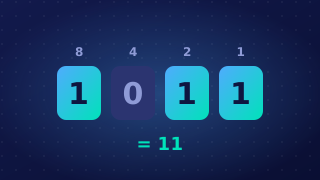
The rightmost bit of a binary number decides whether the whole value is odd or even. A final 0 means the number is even, and a final 1 means it is odd.
Why the rightmost bit decides
Binary place values from the right are 1, 2, 4, 8, 16 and so on. Every place value except the first is an even number. Adding any selection of even numbers always gives an even total, so all the bits to the left of the rightmost bit can only build an even part. The rightmost bit (the least significant bit) has place value 1. When it is 0 it adds nothing, so the total stays even. When it is 1 it adds one, which makes the even total odd.
The rightmost bit does have an effect: it is worth 1 when it is set, and it is the only bit that can change whether the result is odd or even. In 00001010 the rightmost bit is 0, so the number is even: the bits set to 1 are worth 8 and 2, giving 10. In 00001011 the left bits are the same but the rightmost bit is 1, so the number is odd: 8 + 2 + 1 = 11.
| Binary | Rightmost bit | Odd or even |
|---|---|---|
| 00000101 | 1 | Odd |
| 00001010 | 0 | Even |
| 00010011 | 1 | Odd |
Practise this
Edexcel GCSE Computer Science · Binary to Denary Conversion
Edexcel GCSE Computer Science · Denary to Binary Conversion