Creating a Marketing Mix to Support a Product
The marketing mix elements for a good/service
Contents
The marketing mix is the set of decisions a business makes about four marketing elements: product, price, place and promotion. These four elements are commonly called the 4Ps of the marketing mix, and they are the elements to name whenever you are asked about the mix.
| Element | Decision it covers |
|---|---|
| Product | What the good or service is and what makes it appealing to customers. |
| Price | The amount charged for the good or service. |
| Place | Where and how customers can buy the good or service. |
| Promotion | How customers are told about the good or service and persuaded to buy. |
The mix is connected
The 4Ps are not four separate topics. They form a set of connected decisions, because a business works on all four together: changing one element affects the others and the overall plan.
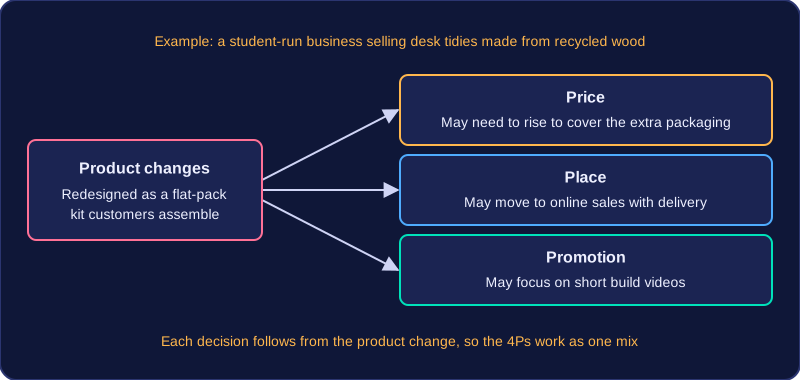
For example, a student-run business sells desk tidies made from recycled wood. If the product is redesigned as a flat-pack kit that customers assemble, the price may need to rise to cover the extra packaging, the place may move to online sales with delivery, and promotion may focus on short build videos. Each decision follows from the product change, so the 4Ps work as one mix.
Product is the element of the marketing mix that covers what the good or service actually is. It includes every choice about the thing being sold, not just its name.
What product decisions include
- Design – how the good looks and works, such as the shape and lid of a reusable water bottle.
- Features – what it does, for example a leakproof lid or a built-in filter.
- Quality – how well it is made and how long it lasts.
- Range – the different versions offered, such as two sizes and five colours.
- Branding – the name and logo that help customers recognise it.
- Packaging – the box or wrapping that protects it and gives information.
- Extra services – added help such as free personalisation, an extended warranty or after-sales support.
For a service, the same ideas apply: a dog-walking service might offer a daily photo update as a feature, a trained and insured walker as a sign of quality, and a free first meet-and-greet as an extra service.
Being different and staying appealing
Product decisions also look at competitors. A business asks what its good or service offers that rivals do not, so customers have a reason to choose it. For example, a bottle with a leakproof lid and free name printing is different from a plain bottle on a supermarket shelf.
Product decisions are not made once. A business can update a product by adding a feature, improving quality, extending the range or refreshing the branding. This keeps it appealing as customers' tastes and competitors' offers change.
Price is the amount charged for a good or service, and the pricing approach is the method a business uses to decide that amount. Price is one of the four Ps of the marketing mix. The approach might start with the business's costs and then be adjusted to suit customers and rivals.
Pricing is not the same as calculating costs. Adding up materials, wages and other expenses tells you what it costs to provide something; the price decision is about what to charge. A price below cost loses money on every sale, even if sales are high.
What shapes the price
| Influence | Question the business asks | Example |
|---|---|---|
| Business costs | Will each sale cover costs and contribute towards profit? | A phone case costs £5 to make and post. Charging £4 would lose £1 per sale. |
| Target market | What will these customers pay, and what do they expect? | Students may pay £14 for a custom case they cannot buy elsewhere, but not £30. |
| Competitors' prices | What do similar businesses charge? | If online rivals charge £12 to £15, a price of £14 sits within the market range. |
Imagine you print custom phone cases. Each case costs £5 in materials and printing. Similar sellers charge £12 to £15, and your customers are students who will pay more for a personal design but compare prices. You set £14: it covers costs, fits what the target market expects and stays close to competitors. Charging £8 might attract more buyers, but it would leave very little after costs and other expenses.
A low price is not automatically best. The price must cover costs and still be an amount the target market is willing to pay, while making sense next to competitors' prices.
Place is the part of the marketing mix that covers where a good or service is available to buy and the route or channel it passes through to reach the customer. Where delivery is used, it is part of the place decision because it is how the customer receives the good.
Choosing where and how to sell
Place decisions include choosing suitable locations or sales channels, such as a shop, a market stall, a website or delivering to customers. A business might use more than one channel: a small pottery could sell mugs at weekend craft markets and also take orders through its own website, posting items to customers. Each channel should make buying convenient for the target market. For example, busy commuters may value ordering online and collecting from a locker at the station, while older customers may prefer a town-centre shop where they can ask questions.
Place is more than a location
Place is not only the physical location of the business. It includes how the good or service is made available, such as home delivery, click and collect, or selling through another shop. If a tutoring company teaches face to face in a rented community-centre room and also offers live online lessons booked through its website, both the room and the online lesson are place decisions.
Why an online presence matters
An online presence is increasingly important because customers expect to find, compare and buy goods or services online at any time. A business that is easy to find and buy from online can attract customers who are shopping in the evening or comparing several businesses. An online shop also lets a small business serve customers outside its local area, with delivery forming part of the place decision.
Promotion is the part of the marketing mix that covers the ways a business makes potential customers aware of its good or service and persuades them to buy it. It tells people the product exists, what it does and why it is worth paying for.
Two jobs of promotion
Promotion works on two fronts. Attracting new customers means people who have never bought before must notice the business, understand the offer and decide it is worth trying. Retaining existing customers means keeping people who have already bought coming back, which is often cheaper because a satisfied customer already trusts the business. A loyalty scheme or an offer for previous buyers nudges someone towards a repeat purchase.
Advertising and non-advertising methods
Advertising is paid-for communication that reaches a wide audience, such as a bus shelter poster or a sponsored social media post. It puts the message in front of lots of people at once, but it is only one part of promotion — promotion does not simply mean advertising.
Promotion also includes non-advertising methods:
- Sales promotions — short-term incentives such as buy-one-get-one-free or money-off vouchers, which push a customer to act now rather than later.
- Public relations and publicity — getting good news about the business noticed, for example a charity it supports posting a thank-you video that mentions it. Because it is not paid for directly, audiences often trust it more than an advert.
- Personal selling — a person talking directly to a potential customer, such as a sales assistant demonstrating a phone, so questions can be answered on the spot.
For example, a kayak hire business might pay for a sponsored post to reach day trippers (advertising), offer a weekday discount on a second kayak (a sales promotion), lend kayaks free to a local youth club and ask it to post about the day (publicity), and have staff on the bank explaining safety gear to passers-by (personal selling). Four methods, one aim: persuade people to book.
Advertising media are the channels a business uses to carry its promotional message to customers. They are grouped into two types: non-digital media, also called traditional media, and digital media.
The two types of media
| Type of media | Examples | What it is good at |
|---|---|---|
| Non-digital (traditional) media | Leaflets, newspapers, magazines, radio, posters and billboards, cinema | Reaching people in a local area, or a group who all read the same paper or magazine. Posters and billboards are seen by people passing, and leaflets land in someone's hand. |
| Digital media | Social media (used for video, feedback and social networks), websites, online banners and pop-ups, SMS text messages, podcasts, vlogs and blogs | Reaching a chosen audience quickly; many let customers reply, comment or click straight through; and the message can be changed without reprinting anything. |
What makes a medium digital is how the message travels – over the internet or as an electronic message – not whether it has sound or moving pictures. Radio, cinema and magazines are non-digital media: a radio advert is broadcast, a cinema advert is shown at the cinema, and a magazine advert is printed, rather than being delivered online.
A worked example
A skateboard and scooter shop in a town centre wants more customers. It prints leaflets to push through doors in nearby streets and puts a poster up at the local skate park, because both are cheap ways to reach people who live close enough to visit. It also posts short vlogs of new boards on social media and buys an online banner on a scooter club's website, so riders from further away can see the products and click through to the shop's own site to check stock. Mixing both types means the shop reaches people who rarely shop online as well as people who spend their evenings on their phones.
Choosing an advertising medium means deciding where to place adverts so the right people see or hear them. The choice depends on the budget, how many people it reaches, how precisely it can target the people the business wants to reach, how long the advert lasts, and whether images, sound or interaction are needed.
| Medium | Advantages | Disadvantages |
|---|---|---|
| Leaflets | Cheap to produce and distribute; can mix text, images and graphics. | Often seen as junk mail and ignored, so their effect is short-lived. |
| Newspapers | Can target a local area; allow longer advertorials (adverts that look like articles). | No animation, sound or video; read and thrown away quickly; readership is falling. |
| Magazines | Target a shared interest; last longer; often read by several people; glossy images. | Long planning, costly, limited reach, and the advert can be lost among others. |
| Radio | Affordable; wide audience; jingles grab attention and stay in memory; can be timed for audiences. | No visual appeal; listeners pay limited attention; limited research data; audiences split across stations. |
| Posters and billboards | Reach large audiences; big formats create impact and build brand awareness. | Can be unnoticed; poor for targeting a specific audience; usually short-term. |
| Cinema | Captive audience; large screen and sound for impact; can be targeted by film. | Very expensive to produce; audience may not be interested in the product. |
A medium should be judged against the budget, target audience and the message that must be conveyed, not assumed to be best because it is expensive or modern. For example, a pottery painting studio with £150 to advertise to local families might choose leaflets or a local newspaper rather than cinema: cinema costs far more and its audience may not want a craft session. A magazine for craft hobbyists could target a shared interest well, but it costs more and needs booking well ahead.
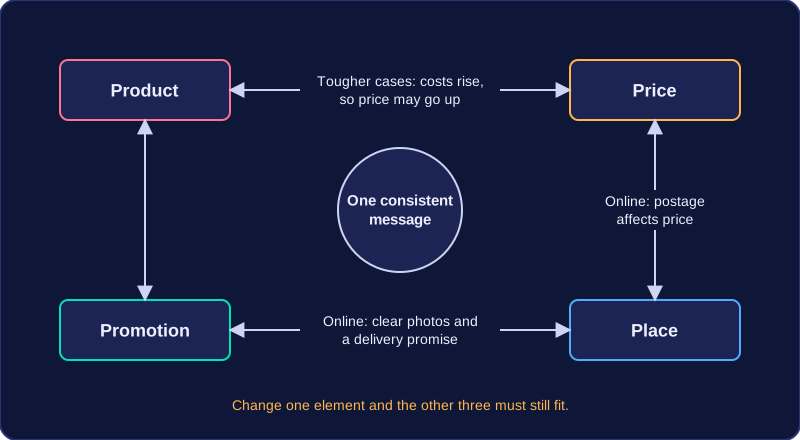
A marketing mix is a blended strategy: product, price, place and promotion are chosen together, not one at a time. A decision about one element changes the others, so the four must fit as a set.
Decisions pull on each other
Suppose you sell custom-printed phone cases from a market stall. If you switch to tougher cases (product), your costs rise, so the price may need to go up. That higher price needs promotion that explains the extra protection, or customers may choose a cheaper stall. Moving sales online (place) adds postage costs and changes how you promote, because you now need clear photos and a delivery promise.
| Change | What else must change |
|---|---|
| Add a second case size | Stock costs rise, price may rise, promotion lists both sizes |
| Start selling online | Postage affects price, photos and delivery details become promotion |
Fit the business, not a textbook
The mix must be consistent with the enterprise's aims and objectives and stay within its budget. A business aiming to be seen as premium should not use the cheapest packaging and constant discounting, because those decisions send a different message. A tight budget might mean using a school newsletter and a stall rather than a large advert.
Adapt the mix to the nature of what is sold, its target market, competitors and the size of the business. A weekend craft club cannot be stored on a shelf, so place and promotion must persuade people to book a session. Parents of young children may need afternoon times and safety information; a larger competitor may offer longer sessions, so the club stresses small groups. A sole trader can run a booking sheet and a local poster, while a larger firm could pay for a wider campaign.
No single right mix
There is no single correct marketing mix. Two businesses selling similar goods can succeed with different mixes because their aims, customers and resources differ. Judge a mix by whether the four elements support one clear message and help the business meet its aims within budget.