Creating a Marketing Mix to Support a Product
Marketing mix elements working together

Contents
Customers often decide whether a price is fair by comparing it with what the product appears to offer. That impression is the perceived quality of the product, and a price that does not fit it makes customers suspicious or unwilling to buy. Price must therefore be consistent with perceived quality.
How customers judge value
Before you buy, you cannot test the product, so you read clues about its quality. The design, the materials used, the features, the packaging and the brand name all add up to an idea of how good the product is. You then weigh that idea against the price. If the two fit together, the price feels fair and you are more likely to buy.
| Price compared with perceived quality | How customers usually react |
|---|---|
| Price much higher than the quality the product seems to offer | They see poor value for money and look elsewhere |
| Price much lower than the quality the product seems to offer | They doubt the quality, guessing it is faulty, old stock or a budget item |
| Price in line with the quality the product seems to offer | They trust the product and accept the price as fair |
A worked example
A small business sells steel water bottles that keep drinks cold for 24 hours. The bottles are sturdy, well finished and boxed neatly. Priced at £34, they sell steadily, because the price matches the tough, long-lasting product customers can see. If the same bottles were priced at £8.99, shoppers would assume the 24-hour claim was exaggerated and the steel was thin, even though nothing about the bottle had changed. A flimsy bottle priced at £34 would be poor value, and most shoppers would leave it on the shelf. A high price on its own does not make a product look premium; it only works when the product looks worth it.
Promotion shapes the price customers expect to pay. An advert, social media post or in-store display is often the first time someone sees a product, so it creates an impression of its value before they check the price.
If the actual price does not match that impression, customers can be put off buying. A polished campaign that suggests something special can make a very low price feel confusing, while a cheap-looking promotion can make a high price feel too expensive. The customer may decide the product is overpriced or that the advert was misleading.
Match the promotion to the pricing strategy
The pricing strategy should influence the style of promotion. A premium-priced product suits high-quality, well-designed promotional material that supports a premium image. A low-priced product suits simple, low-cost promotion that keeps costs down and communicates value for money.
| Pricing strategy | Promotion style that fits | Why it works |
|---|---|---|
| Premium price | Professional photos, polished video and carefully written descriptions | The quality of the promotion supports the higher price and makes it feel believable. |
| Low price | A simple poster, short social post or clear price label | Keeps promotion costs low and makes value for money obvious. |
For example, a mobile phone repair shop charges £120 for a screen repair and £12 for a battery health check. The £120 repair is promoted with close-up photos of the repair bench, a short video of a technician fitting a screen and a clear written explanation of the 12-month guarantee. The £12 check gets a small counter card with a bold price. Each promotion matches its price: the detailed material shows why the repair costs £120, while the simple card makes the £12 check an easy, low-risk purchase.
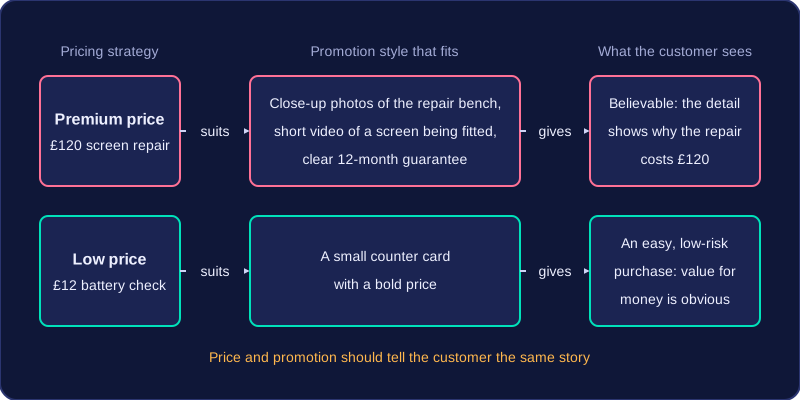
Price and promotion should therefore tell the customer the same story. When the promotion creates the right expectation and the price fits it, customers are more likely to see the offer as believable and fair.
Promotion must be aimed at the target segment — the group of customers the product is designed for. If the words, images, advertising medium and tone do not appeal to that group, the product will not sell well, however good it is.
For example, imagine you sell bright, leak-proof water bottles to secondary school students. A short video on a social media app popular with teenagers, showing a bottle being dropped into a school bag and still not leaking, uses images and a medium that suit that segment. It highlights a feature (leak-proof lid) and a benefit (no soggy books) that those customers care about. The same bottle advertised in a gardening magazine with the headline keeps cuttings fresh would reach the wrong audience and waste money.
Why product and promotion depend on each other
A good product will not sell unless it is promoted effectively. A well-designed product that is promoted poorly may be overlooked because customers do not know it exists or cannot see why it is worth buying. Promotion should therefore highlight the product features and benefits that matter to the target segment, so customers can see the value.
The product also shapes the promotion: its design, colours and main benefit give the promotion something specific to say and show. Promotion results can also reveal which features customers respond to, which can influence later product decisions. Good promotion makes those strengths visible to the right people, while promotion aimed at the wrong audience fails to attract the customers the product was made for.
Place is where and how a product is made available to customers, such as a shop, website or market stall. It must match the image and quality of the product, because customers read meaning into where they find something and use that to judge it.
An unsuitable outlet can change how customers perceive a product. A cheap pair of trainers on display in a smart sports shop may look like a clever bargain, or shoppers may doubt they are genuine, while an expensive pair of running shoes in a discount clearance warehouse may be taken for faulty stock or an old model. The outlet is part of the product's image, even when the product itself has not changed.
How place affects price
Where a product is sold also affects the price that can be charged. An affluent location can support higher prices because customers there may be willing and able to pay more. Businesses in areas with lower incomes usually need to set lower prices. The cost of premises must be considered too, because expensive rent or running costs may force the business to charge a higher price.
| Outlet | Price it supports | Image it creates |
|---|---|---|
| Premium department store | Higher price | High quality and exclusive |
| Discount warehouse | Lower price | Value for money |
| Boutique in an affluent town | Higher price | Stylish and special |
| Budget online marketplace | Lower price | Low cost and convenient |
Place, price and image together
Imagine a small business that builds wooden garden benches. In a garden centre in a prosperous town, the rent is high but shoppers expect quality, so £120 a bench feels reasonable. The same benches in a discount clearance warehouse look expensive beside cheaper flat-pack alternatives; a lower price of £70 and plainer labelling would fit that outlet better. Place, price and image should therefore support one another, so the customer gets one clear message about what the product is worth.
Customers do not judge product, price, place and promotion one at a time — they see the whole mix as a single offer. Getting one element wrong weakens the whole mix, because customers weigh all four together when they decide whether to buy.
Why one weak element drags the rest down
- A poor product is still seen as poor, however well it is promoted. Customers judge the product itself when they use it, so a big advertising campaign only tells more people about something that will disappoint them.
- The wrong price can stop a good, well-promoted product from succeeding, because customers may see it as too expensive for what it is, or too cheap to trust.
- The wrong place can do the same. If the product is sold where your target customers do not shop, or in an outlet that does not fit its image, they may never come across it — or may think differently about it once they do.
- Weak promotion leaves a strong product unnoticed, so the other three decisions never get the chance to work.
A worked example
A small business launches a range of school backpacks aimed at Year 7 to Year 11 students. The bags are tough, waterproof and well designed, and the short videos on social media are lively and skilfully made. But the price is set at £95 and the bags are sold only in an outdoor equipment shop on a retail park outside town. Few students browse that shop, and most families think £95 is far too much for a school bag, so sales stay low. The good design and the clever promotion cannot rescue the mix: price and place pull against product and promotion, and customers end up seeing the whole offer as poor value.
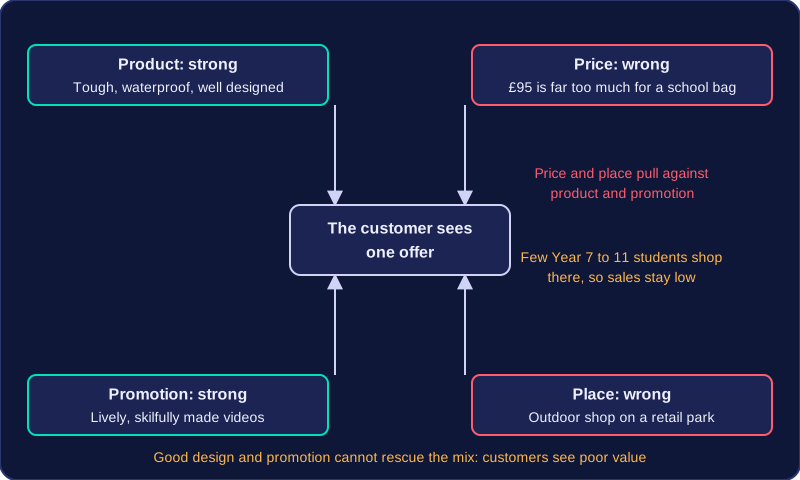
A weakness in any one element therefore damages how customers see the product and reduces sales. The elements have to support each other so that the mix works as a whole.
Brand image is the impression customers have of a brand. When product, price, place and promotion are carefully adjusted and work together well, a business can create a specific and planned brand image, rather than leaving customers to form a random impression.
Positioning means choosing where the brand sits in the market: premium, economy, or somewhere in between. The four elements must tell the same story. If one element suggests something different, the image becomes muddled.
| Element | Premium position | Economy position |
|---|---|---|
| Product | High-quality materials, neat finish and protective packaging | Simple, functional product and simple packaging |
| Price | High enough to reflect the quality | Lower price that communicates value |
| Place | Outlets used by premium customers | Value outlets where budget customers shop |
| Promotion | Well-designed, high-quality advertising | Low-cost, straightforward promotion |
Larch is a fictional premium backpack brand. Its bags use strong recycled fabric, metal buckles and neat stitching. They cost £75. They are sold in independent outdoor shops, and adverts appear in a specialist walking magazine with professional photography. Each choice supports the premium position. A rival, Campus Carry, uses basic fabric, costs £18, sells on supermarket shelves and uses a short radio advert with clear shelf labels. This can build a successful economy image, not a failed premium one, because all four elements agree.
Not every brand needs a premium position. An economy position can work well when the lower price, simple packaging, suitable outlets and low-cost promotion all support value for money. A high price alone does not make a brand premium; the product, place and promotion must match it too.