Hexadecimal to Denary Conversion
Converting Hexadecimal to Denary by Place Value

To convert a two-digit hexadecimal number to denary by place value, use the fact that hexadecimal is base 16. The place values are 16 and 1: the left-hand digit is multiplied by 16 and the right-hand digit by 1, then the two results are added together.
Before you multiply or add, change any letter digit into its denary value. Digits 0 to 9 keep their value; A to F stand for 10 to 15.
| Hexadecimal digit | Denary value |
|---|---|
| A | 10 |
| B | 11 |
| C | 12 |
| D | 13 |
| E | 14 |
| F | 15 |
Using place value
- Change any letter digit to its denary value.
- Multiply the left-hand digit by 16.
- Add the value of the right-hand digit.
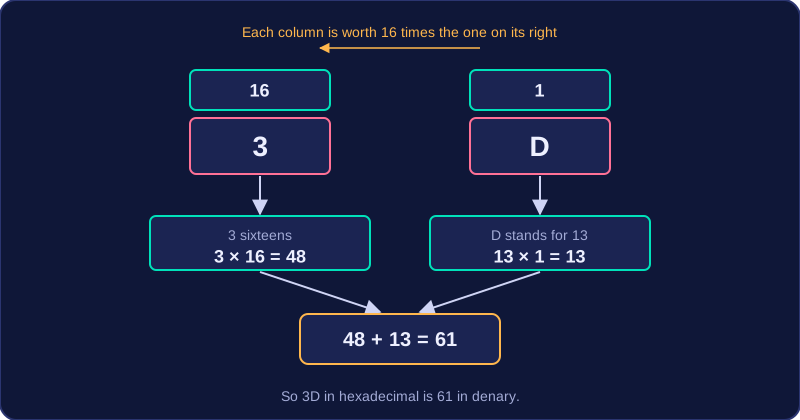
The multiplication step matters because the digits sit in different columns and do not have equal worth. For example, in D4, change D to 13, work out 13 × 16 = 208, then add the 4 from the right-hand position: 208 + 4 = 212. So D4 in hexadecimal is 212 in denary.
Here is another example. Change B in 6B to 11. Take the 6, multiply it by 16, then add the 11: 6 × 16 = 96, and 96 + 11 = 107. Write each stage clearly so your working shows the letter changed, the multiplication by 16 and the final addition.
A to F are not alphabet positions: A means 10, not 1, and F means 15, not 6. Because two hexadecimal digits give 256 possible patterns, a two-digit hexadecimal number converts to a denary value from 0 to 255.
Practise this
OCR GCSE Computer Science · Hexadecimal to Denary Conversion