Arithmetic Operators
Arithmetic Expressions
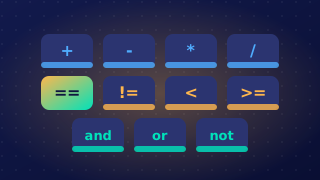
An arithmetic expression is a combination of values, variables, constants and operators that works out a result. The result can be stored in a variable using assignment (=) or displayed with print().
For example, if score = 18 and bonus = 4, then score + bonus is an expression. Its result, 22, can be assigned with total = score + bonus or displayed directly.
Arithmetic operators work on whole numbers, real numbers, variables and constants. A constant is a named value that stays the same, such as ITEM_PRICE = 2.5, and it can be used in an expression just like a variable. Several operators can appear in one expression, for example number_of_items * ITEM_PRICE.
Whole numbers and real numbers
An expression that uses only integers produces an integer result, unless it uses division with /. In Python 3, / always produces a real number, even when both values are whole numbers, so 20 / 4 gives 5.0, not 5.
If an expression mixes an integer and a real number, the result is a real number. The integer is treated as a real value for that calculation. For example, 7 + 2.5 gives 9.5, because 7 is treated as 7.0 during the addition.
| Expression | Types involved | Result |
|---|---|---|
9 + 5 | two integers | 14 (integer) |
9 + 5.0 | integer and real | 14.0 (real) |
12 / 3 | two integers, / used | 4.0 (real) |
12 + 0.5 | integer and real | 12.5 (real) |
Expressions in a program
This program stores two values, combines them in an expression and displays the result. The expression weekday_hours + weekend_hours mixes an integer and a real number, so the output is real.
weekday_hours = 3
weekend_hours = 2.5
total_hours = weekday_hours + weekend_hours
print(total_hours)
print(weekday_hours * 2)
Output:
5.5
6
The second expression, weekday_hours * 2, uses only integers, so its result is an integer.
Practise this
Edexcel GCSE Computer Science · Arithmetic Operators