Network Security Risks
Network Security Risks
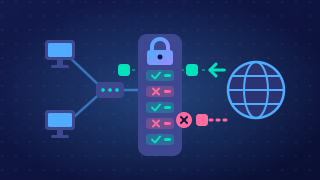
Networks let devices share files, messages and services, but the data they carry is often personal, financial or confidential. That is what makes them a target: anyone who can reach the network, from another device on the same Wi-Fi or from the other side of the world, may try to steal, change or destroy that data or stop it being available.
Threats to networks
| Threat | What happens | Example |
|---|---|---|
| Social engineering | People are tricked into revealing information or giving access | An email pretending to be IT support asks for your password |
| Denial of service | A service is flooded with requests until real users cannot use it | Fake requests stop a ticket site selling tickets |
| Brute-force | Many username and password combinations are tried until one works | Software tries a list of common passwords on a login page |
| Data interception | Data is captured while it travels across a network | Someone on the coffee shop Wi-Fi reads everyone's traffic |
Social engineering attacks the person rather than the technology, so a firewall cannot stop it. A phishing email looks genuine but pushes you to hand over a password or click a link. Because it relies on trust, training staff to spot it matters as much as software does.
A denial of service (DoS) attack steals nothing; it makes a service unavailable. If a hospital's appointment booking system is flooded, patients cannot book and staff must fall back on paper lists. Requests sent from thousands of infected computers at once are also hard to block.
A brute-force attack relies on speed rather than cleverness, trying thousands of combinations every second. Short, common passwords fall quickly, while a long password of mixed characters would take far too long to guess.
Data interception happens because data crossing a network passes through cables and radio signals that other people may be able to read. Traffic on an unencrypted wireless connection can be captured as it passes, so even a secure device can leak data once it sends it.
These threats are why an organisation must protect its systems and data, and why it first looks for its own weaknesses using penetration testing and ethical hacking.
Practise this
Edexcel GCSE Computer Science · Network Security Risks
Edexcel GCSE Computer Science · Preventing Network Security Risks
Edexcel GCSE Computer Science · Computer Misuse Act