Denary to Hexadecimal Conversion
Converting Hexadecimal to Denary
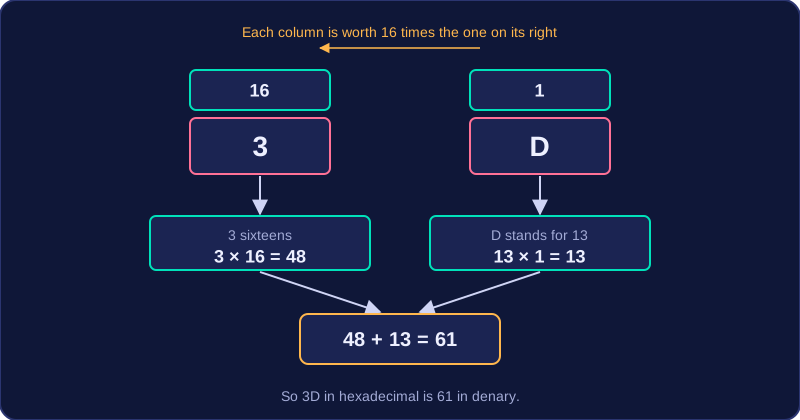
Converting hexadecimal to denary means finding the ordinary number that a hexadecimal (hex) value stands for. In a two-digit hex number, the left-hand digit sits in the sixteens column and the right-hand digit sits in the ones column, because each column is worth 16 times the one on its right.
Place values of 16 and 1
Label the columns 16 and 1. The left digit tells you how many sixteens there are, and the right digit tells you how many ones. That is why you multiply the left digit by 16 and then add the right digit. A two-digit hex value such as 3D is not “thirty-something”: it means three sixteens plus thirteen.
| Hex digit | Calculation | Value |
|---|---|---|
| 3 (sixteens) | 3 × 16 | 48 |
| D (ones) | 13 × 1 | 13 |
| Total | 48 + 13 | 61 |
So 3D in hexadecimal is 61 in denary.
Letters stand for 10 to 15
A to F are single hex digits with values 10 to 15: A = 10, B = 11, C = 12, D = 13, E = 14 and F = 15. Swap each letter for its value before doing the arithmetic. For E9: E = 14, so 14 × 16 = 224, and 224 + 9 gives 233.
Single digits and checking
A one-digit hex value needs no multiplication, because it sits in the ones column: 7 in hex is 7 in denary, and D in hex is 13 in denary. To check a two-digit answer, convert it back to hexadecimal; if the original digits come back, your value is correct.
Practise this
Edexcel GCSE Computer Science · Denary to Hexadecimal Conversion