Denary to Binary Conversion
Nibbles in Binary
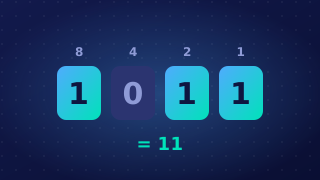
A byte can be split into two nibbles of four bits each. Each nibble is a small binary number in its own right, which makes a long pattern of 0s and 1s easier to read and convert.
The nibble on the left is the high nibble, holding the place values 128, 64, 32 and 16. The nibble on the right is the low nibble, holding 8, 4, 2 and 1. The place values still double from right to left across the whole byte — the split does not break the pattern.
Converting one nibble at a time
Take the denary number 97. In the high nibble, 128 is too big, so the first bit is 0. The next place value, 64, fits, so that bit is 1 and 97 − 64 = 33 is left. Next, 32 fits into 33, so that bit is 1 and 33 − 32 = 1 is left. The 16 is too big for the 1 remaining, so that bit is 0. The high nibble is 0110.
Now the low nibble, starting with the 1 left over. The place values 8, 4 and 2 are too big, so they are 0; the final place value, 1, fits exactly, so the last bit is 1. The low nibble is 0001. Putting them together gives 0110 0001.
Rules for the final answer
- The answer must contain only the digits 0 and 1 — never a denary digit left over from your working.
- Each nibble must be exactly four bits, so the full answer is always eight bits; keep any leading zeros in a nibble.
- You may put a single space between the two nibbles, as in 1010 1100, to make the answer easier to read.
Writing the nibbles in the wrong order, low nibble first, gives a pattern that means a completely different number, so always build the high nibble on the left.
Practise this
Edexcel GCSE Computer Science · Denary to Binary Conversion
Edexcel GCSE Computer Science · Binary to Hexadecimal Conversion