Binary Shifts
Shifting Unsigned Integers
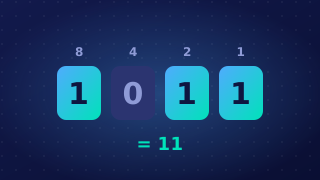
An unsigned integer is stored as a binary pattern in which every bit adds to the value. Moving that pattern sideways is called a shift, and it gives a quick way to multiply or divide by powers of two without carrying out a full calculation.
One place at a time
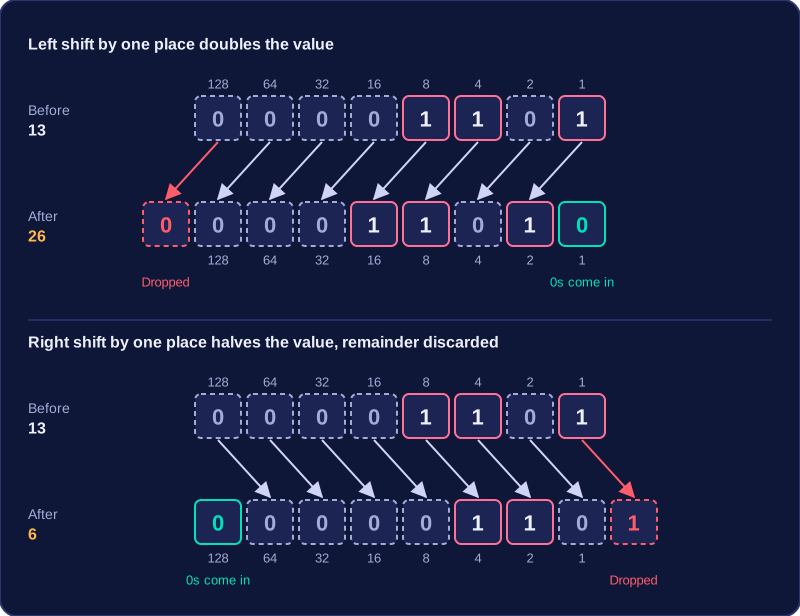
A left shift by one place moves every bit one position to the left, so each bit lands on a place value twice as large. The whole value therefore doubles. Starting with 00001101 (13), a left shift gives 00011010, which is 26.
A right shift by one place moves every bit one position to the right, so each bit lands on a place value half as large. The value halves. If the number is odd, the 1 bit that drops off the right-hand end is lost, so any remainder is discarded: 00001101 (13) shifted right becomes 00000110, which is 6, because 13 ÷ 2 = 6.5 and the 0.5 is thrown away.
Several places at once
Each place you move doubles or halves the value again. A left shift by n places multiplies by 2 to the power n, and a right shift by n places divides by 2 to the power n, discarding any remainder. So two places means multiply or divide by 4, and three places means multiply or divide by 8.
Using the same 8-bit pattern 00001101 (13):
| Shift | Result | Denary | Calculation |
|---|---|---|---|
| Left 1 | 00011010 | 26 | 13 × 2 |
| Left 2 | 00110100 | 52 | 13 × 4 |
| Right 1 | 00000110 | 6 | 13 ÷ 2, remainder 1 discarded |
| Right 2 | 00000011 | 3 | 13 ÷ 4, remainder 1 discarded |
The direction decides whether you multiply or divide, and the number of places decides which power of two you use. A left shift by three on 00001101 gives 01101000 (104), which is 13 × 8. A right shift by three gives 00000001 (1), because 13 ÷ 8 = 1 remainder 5, and that remainder is discarded.
Practise this
Edexcel GCSE Computer Science · Binary Shifts